Further education college statistics
These statistical releases are produced by the department using data collected from the further education (FE) colleges in Northern Ireland.
Further education sector activity summary
Further Education (FE) Colleges are the main providers of further education and training in Northern Ireland (NI). The sector plays a central role in raising literacy and numeracy levels and in up-skilling and re-skilling the population through a broad range of courses leading to qualifications, particularly at National Qualifications Framework (NQF) and Qualifications and Credit Framework (QCF) levels 2 and 3 and equivalents. Higher Education (at level 4 and above) is also delivered across the FE Colleges.
It should be noted that students may be enrolled on more than one course at a given time and may, therefore, be counted as having two or more enrolments.
Key Points
All enrolments
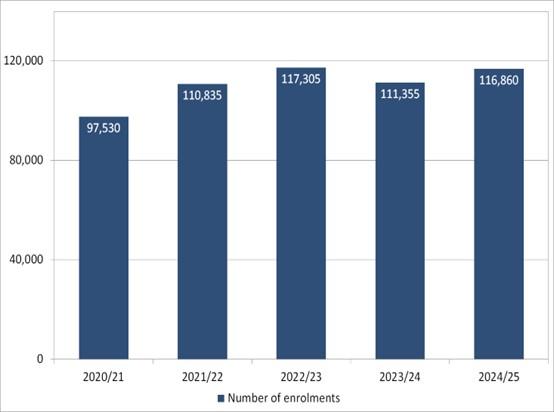
The number of FE College enrolments rose by a net 20% between the pandemic-impacted 2020/21 (97,530) and 2024/25 (116,860), including a 5% increase in the most recent academic year.
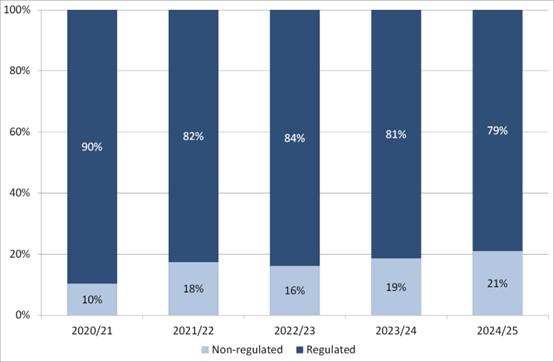
The regulated share of enrolments decreased from 90% in 2020/21 to 79% in 2024/25.
Over two-fifths (42%) of 2024/25 enrolments were mainstream funded by the Department for the Economy.
Regulated enrolments
Of the 92,160 regulated enrolments in 2024/25, 82% were at Level 2 or above, down from 83% in 2020/21.
The age structure of the student population on regulated enrolments is becoming more polarised, with the combined aged 19 and under and 25 and over share of such enrolments increasing from 85% in 2020/21 to 87% in 2024/25.
Three-quarters (74%) of regulated enrolments are part-time, while more males than females study full-time.
Higher Education enrolments decreased by a net 1%, from 10,035 in 2020/21 to 9,925 in 2024/25.
FE Sector regulated enrolments are fairly evenly spread across the four most deprived relative multiple deprivation quintiles, although considerable variation occurs at college level.
Qualifications and Performance
Although the success rate (the percentage of final year regulated enrolments of students who complete and achieve a qualification) remained at 79% in net terms, 12% more qualifications were awarded in 2024/25 (58,055) than in 2020/21 (52,000).
Students
The number of FE sector students rose by a net 19% between 2020/21 (55,970) and 2024/25 (66,690), including a 5% increase in 2024/25.
In 2024/25, 3% more students were enrolled on regulated courses (52,375) than in 2020/21 (50,810).
The number of students achieving regulated qualifications increased by a net 9%, from 33,925 in 2020/21 to 37,070 in 2024/25.
Enrolments
The number of enrolments rose by a net 20% between 2020/21 (97,530) and 2024/25 (116,860).
The number of FE College enrolments rose by a net 20% between the pandemic-impacted 2020/21 (97,530) and 2024/25 (116,860), including a 5% increase in the most recent academic year. Notably in 2024/25 were increases in NRC (up 26%, to 15,565), NWRC (up 21%, to 15,455) and SWC (up 14%, to 23,245) (Table 1).
The bulk of the net 20% (19,325) increase in enrolments between 2020/21 and 2024/25 were part-time (up 18,205), non-regulated (up 14,535) and / or relating to students aged 19 and under (up 12,695) (Table A2 and Table A8).
Figure 1: The number of enrolments rose by a net 20% between 2020/21 and 2024/25
Regulated share of enrolments
Over the period 2020/21 to 2024/25, the regulated share of enrolments has decreased.
Between 2020/21 and 2024/25, the regulated share of enrolments has decreased in net terms from 90% to 79%. This included a downward spike to 82% in 2021/22 following the pandemic-impacted 2020/21 (Table A5).
Figure 2: Regulated share of enrolments has decreased in net terms from 90% in 2020/21 to 79% in 2024/25
Funding streams
Over two-fifths of enrolments are funded by the Department for the Economy.
Of the 116,860 enrolments in 2024/25, over two-fifths (42%) were mainstream funded by the Department for the Economy, 29% were funded through government training programmes, 13% were cost recovery and 5% were funded through the Entitlement Framework programme. The remaining 11% ‘Other’ enrolments included programmes like Skill Up and Skills Focus (Table A10).
Figure 3: Most enrolments were either mainstream funded by DfE or through government training programmes

Further education sector activity
The statistics presented in this bulletin cover the characteristics of those enrolling in FE colleges and trends across a range of variables including sex, age, mode of attendance, provision area, level of study, subject area, areas of deprivation, funding streams, and performance (retention, achievement and success rates) over a five year period.
To view the statistical bulletins, please select the period required.
- Further Education Sector Activity in Northern Ireland: 2020/21 to 2024/25
- Further education sector activity in Northern Ireland: 2019/20 to 2023/24
- Further education sector activity in Northern Ireland: 2018/19 to 2022/23
- Further education sector activity in Northern Ireland: 2017/18 to 2021/22
- Further education sector activity in Northern Ireland: 2016/17 to 2020/21
- Further education sector activity in Northern Ireland: 2015/16 to 2019/20
From the academic year 2013/14 onwards, the term ‘‘Regulated’ (to align with the definition employed by the Office of Qualifications, Assessment and Examinations (OFQUAL)) will now be used in regard to this type of provision within FE. This cohort of FE provision is comparable with the previous figures for Professional and Technical.
Readership survey
An analysis of the FE activity readership survey conducted in September 2019 is available:
Additional outputs
Further education (including Essential Skills) ad hoc tables are produced in response to user requests and contain combinations of data that are not available in standard publications.
Further education equality tables have been produced in response to a request from the Equality Commission for Northern Ireland (ECNI) for its ‘Measuring Equality in Northern Ireland’ monitoring framework.
All historical reports are available at the following links:
- Further education statistical fact sheets
- Further education sector activity in Northern Ireland (historical)
- Professional and technical enrolments in the Northern Ireland further education Sector
Quality report on further education activity
A report including information on different dimensions of quality (relevance, accuracy, timeliness and punctuality, accessibility and clarity, coherence and comparability) can be accessed below.
New rounding and suppression approach (Further Education and essential skills)
DfE outlines the new rounding and suppression approach to official statistics on FE sector activity and essential skills.