Biomethane Strategy and Policy Framework - Supporting Energy and Agricultural Resilience, Nutrient Management and Decarbonisation
Consultation on a sustainable regional approach for
Biomethane Strategy and Policy Framework - Supporting Energy and Agricultural Resilience, Nutrient Management and Decarbonisation
Joint Ministerial Foreword
We are pleased to publish this consultation on a Biomethane Strategy and Policy Framework.
Biomethane has the potential to play an important role in our future energy system. The Energy Strategy committed to replacing fossil fuels with renewable sources of energy, and biomethane can provide an alternative to natural gas for businesses and homes, while supporting industrial decarbonisation and strengthening energy resilience.
The development of a sustainable biomethane sector also presents a significant economic opportunity. It supports the ambitions set out in the Programme for Government by contributing to regional balance, decarbonisation and good jobs. This region is well placed to benefit from that opportunity with a strong agri-food sector, and expertise in anaerobic digestion providing a solid foundation for growth.
We face many significant and interconnected challenges. We must strengthen resilience in our farming sector, improve water quality, address nutrient surpluses, support a just transition to a greener economy, restore biodiversity and reduce greenhouse gas emissions. These issues cannot be addressed in isolation. Biomethane has the potential to contribute to these objectives when developed sustainably and responsibly.
As a renewable energy source produced from organic materials, biomethane can reduce reliance on fossil fuels. Its benefits extend beyond energy, offering opportunities for better nutrient management, a more circular economy, rural economic growth and the development of innovative low-carbon products and services.
However, any future biomethane sector must be guided by strong environmental principles. We have seen the impacts of declining water quality and excess nutrients in our rivers, lakes and loughs, particularly at Lough Neagh. Public confidence will depend on the sector delivering positive environmental outcomes while avoiding unintended consequences.
The consultation is the result of cross-departmental working and engagement with industry stakeholders. It seeks views on the key policy measures that may be required to support the development of a sustainable local biomethane sector. These include market support mechanisms, network connections, certification arrangements and the broader policy framework needed to enable long-term growth.
We encourage all interested parties to participate in this consultation. Your views will help shape future policy and ensure that it is balanced, evidence-based and aligned with our wider energy, environmental and economic ambitions.
Dr Caoimhe Archibald, Minister for the Economy
Andrew Muir MLA, Minister of Agriculture, Environment and Rural Affairs
How to Respond
DFE and DAERA welcome your views and comments on this consultation for a Biomethane Strategy and Policy Framework, including on the questions set out in this paper. This consultation will be hosted online and can be found at NI Direct - Citizen Space. We would encourage responders to utilise Citizen Space as it allows the results to be collated faster.
Alternatively, you can respond to this consultation via email to biomethaneDfE@economy-ni.gov.uk or you can respond in writing to the DfE Gas Team at Department for the Economy, Adelaide House, 39-49 Adelaide Street, Belfast, BT2 8FD.
To respond via email or letter submit the response form provided no later than 5pm on 15 December 2026. Enquiries can also be forwarded to the email address above.
When responding via email or in writing, please state whether you are responding as an individual, or representing the views of an organisation - and if so, please state the name of the organisation. Also, quote the following Consultation Reference: Consultation – Biomethane Strategy 2026.
Privacy, Confidentiality and Access to Consultation Responses
Following closure of the consultation, responses will be analysed, and a summary departmental response drafted and published. Personal data, such as names and email addresses, will not be published as part of this process. In addition, we do not intend to list any organisations that have responded to the consultation in any published report. For more information about what we do with personal data please see DfE’s privacy notice.
Your response, and all other responses to this consultation, may also be disclosed on request in accordance with the Freedom of Information Act 2000 (FOI) and the Environmental Information Regulations 2004 (EIR); however, all disclosures will be in line with the requirements of the Data Protection Act 2018 (DPA) and the General Data Protection Regulation (GDPR) (EU) 2016/679.
Background
Biomethane – more than energy.
Biomethane is a renewable gas predominately produced via the anaerobic digestion (AD) of organic matter in an oxygen free environment. This process produces biogas which consists largely of methane and carbon dioxide (CO2). The biogas can be upgraded with the removal of CO2 and other contaminants to produce biomethane. Biomethane can then be used to replace natural gas in the gas grid, to produce electricity or as vehicle fuel.
For many industrial heat applications, biomethane is the simplest, drop-in replacement fuel that enables decarbonisation of process heat where electrification is not possible. It is classed as a renewable energy source when the organic feedstocks (plants and organic wastes) that it is produced from originate from the capture of atmospheric CO2 via photosynthesis. This results in the net CO2 emissions to the atmosphere being significantly different when comparing biomethane and its fossil equivalent1. While the full carbon saving from biomethane is dependent on feedstocks and operation, its use significantly reduces the reported emissions when compared to fossil equivalents when sourced from well-run AD plants.
Our region possesses one of the strongest biomethane feedstocks bases due to the scale and success of the agri-food sector. Academic research2 has shown that agricultural and other organic feedstocks could produce more than 80% of the region's gas distribution network demand (approximately 7.6 TWh) if a mission-based approach was adopted for resources in proximity to the existing gas infrastructure.
At present over 80 AD plants produce biogas successfully with the majority receiving support via the Northern Ireland Renewables Obligation (NIRO) scheme which closed to new entrants in March 2017. AD also produces digestate, a residual organic solid or slurry which is often rich in nutrients. Consequently, growth in AD leads to an increase in the volume of digestate. If typical animal feeds such as grass or maize are directed to AD plants rather than food for livestock, then the resultant digestate slurries can have a higher nutrient density than digestate from AD fed by organic waste feedstocks. This is because livestock convert a proportion of the nutrient in animal feeds to products such as milk or protein.
Given the nutrient excess issues which are impacting our land and water bodies it is necessary to consider the need for nutrient control in a biomethane strategy. As the AD process typically concentrates nutrient in the digestate residue, the technology also offers the opportunity to facilitate regional nutrient management in parallel. Therefore, implemented correctly, AD as part of a wider system is expected to deliver dual benefits to the region’s economic and environmental needs. However, done badly it could result in significant environmental harm.
Options for digestate management include spreading to land with an established nutrient need or further processing to generate exportable products including biofertilisers and other carbon and nutrient dense products. Similarly, the biogenic CO2 removed during the upgrading of biogas is also a potentially valuable product to support a range of established or emerging industries.
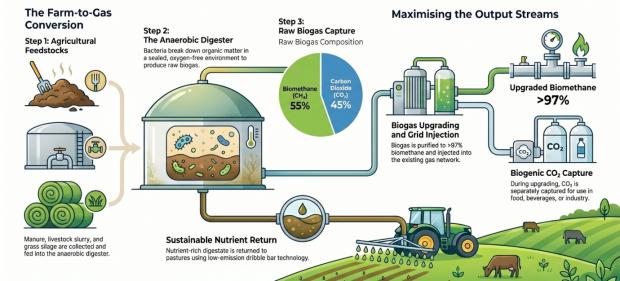
Given the complex economics of AD systems, a holistic understanding of the potential markets for any stackable revenue streams is needed. Also, any biomethane strategy that supports the regional economy needs to include a range of other considerations. These span greater understanding of the anticipated future energy mix demands (heat, power, transport), environmental and nutrient management controls as well as impacts on the wider carbon emissions legislation. AD can also present opportunities for rural areas, including new jobs and investment, contributing to our commitments to ensuring a just transition as we seek to reduce emissions. Hence, while AD is considered within this consultation as the primary tool to produce biomethane it cannot be considered in isolation of wider impacts.
The importance of Nutrient management
Our region has a structural nutrient surplus, particularly in phosphorus (P), which is contributing to the eutrophication of rivers, lakes and loughs, including Lough Neagh. While such issues are not unique to here and exist across the world, there is a clear need for nutrient management to exist alongside agriculture and other sectors to protect waterways.
DAERA’s Nutrients Action Programme3 (NAP) represents the main regulatory framework for reducing agricultural nutrient pollution, especially nitrogen (N) and phosphorus (P) losses from livestock manures, chemical fertilisers and other nutrient-containing materials. The associated regulations are designed to support effective nutrient management enabling farmers to produce high-quality food at reasonable cost for consumers with minimal environmental pollution.
NAP’s strength is that it creates a common regulatory floor across the whole farm sector. It adds controls to when, where and how nutrients are managed on farms; links manure and fertiliser use to crop need; and gives DAERA an enforcement route. Despite this, the Office for Environmental Protection’s 2026 review4 concluded that the 2019 NAP regulations have been insufficient to improve water quality and need to be strengthened and more strongly implemented.
NAP has historically relied on rules about spreading, storage and timing, while the more significant challenge is the nutrient surplus in the livestock system. DAERA’s analysis states that at a regional level there is more than enough phosphorous in manure/slurry to meet crop requirements, but that better distribution and efficient use are needed; it also notes that around 40% of agricultural land has excess soil phosphorous5.
Simply moving slurry from one farm to another, or to an AD plant which then land spreads digestate offers one solution, however this only works if the receiving land has a genuine nutrient demand.
The revised NAP consultation for (2027-2030)6 aims to carry forward existing measures and add stronger controls, especially on phosphorous, ammonia and slurry management. DAERA’s proposals include:
- A 30% phosphorous balance reduction at the national level;
- A Nutrient Stewardship Programme to replace the current Derogation;
- Restrictions on chemical phosphorous fertiliser;
- Mandatory low-emission slurry spreading equipment on larger farms;
- Additional reporting of organic manure movements, including confirmation of receipt;
- Stronger enforcement and additional IT systems to support farm businesses in improving nutrient management.
Such measures are designed to help address the most significant challenge namely the overall nutrient surplus in the livestock system.
It also refers to the potential facilitating role of AD and nutrient processing for recording the movement of separated slurry solids and slurry nutrients. This parallels other jurisdictions, such as Denmark, France and the Netherlands, who have shown how biomethane production from farm wastes can be leveraged to also address environmental consequences of livestock production. In these cases, substantial reductions in phosphorous, nitrogen and ammonia losses to the environment have been achieved through development of a complementary biomethane and digestate management sector.
Clearly AD on its own does not mitigate nutrients. While the technology converts organic material into biogas and digestate, most of the phosphorous remains in the digestate fraction. Therefore, an AD plant only helps NAP compliance if the digestate is further processed so that nutrients are recovered and concentrated for export or sequestration. Hence, AD is one step within a system and while the first step focuses on feedstock capture other steps are required for energy extraction and upgrading, followed by digestate separation and processing as shown in Figure 2.
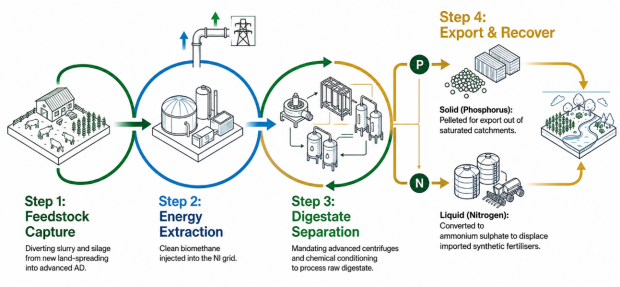
The co-location of digestate management technology alongside AD is therefore important and has been successfully demonstrated in the recent DAERA funded SULS Phase 2 programme which highlighted the opportunity for the export of phosphorous from digestate via marketable products such as fertiliser. Recognising this market the recent NAP consultation encourages the use of “processed organic fertilisers” as a substitute for “chemical fertilisers” in the regional market as well as export of surplus nutrients.
Overall, the latest NAP proposals signal a new direction that is much more clearly nutrient management focused with greater recognition of the potential for post-farm gate treatments which support compliance. This is important as diffuse pollution results when too much nutrient enters the farm system through feed, fertiliser and imported organic manures compared with what leaves in agricultural and related products.
Therefore, for farms seeking phosphorous balance reductions or an excess of nitrogen, a useful service is one that can remove measurable quantities from the farm. Audit trails will be essential to show that nutrients are exported from the farm and gone to a legitimate end use and not applied to land where they are not required. DAERA already recognises slurry separation and export of separated slurry solids for reducing a farm’s phosphorous balance, and the SULS initiative specifically developed and tested processes to separate slurry and remove phosphorous in the separated solids7.
Gas Regulation
The conveyance and supply of gas is regulated by the Utility Regulator (UR) in accordance with its statutory duties and policy set by DfE. Biomethane falls within the definition of gas in the Gas (Northern Ireland) Order 1996.
UR’s principal objective in relation to gas can be found in Article 14 of the Energy (Northern Ireland) Order 2003 and states that:
“….the principal objective of the Department and the Authority in carrying out their respective gas functions is to promote the development and maintenance of an efficient, economic and co-ordinated gas industry in Northern Ireland.”
In doing so, the UR will have regard to the need to ensure a high level of protection of the interests of current and future consumers of gas, and the needs of vulnerable consumers.
Gas transmission companies own and operate the high-pressure transmission network which provides for the bulk transport of gas, including the undersea interconnectors from Great Britain (GB). The Gas Distribution Network (GDNs) operators provide the local distribution networks to which most consumers connect.
The gas network was designed for unidirectional flow, that is to take gas from GB via the transmission pipelines and feed it to the power stations connected to the transmission networks and on into the distribution networks for offtake by industrial and commercial users and domestic premises. The network has not historically needed to enable injection of gas into either the transmission pipelines or into the distribution zones and the distribution zones are not connected to each other such that gas can flow between them. Likewise, the regulatory framework for the conveyance of gas did not need to provide for the injection of gas at points on land.
As interest in injecting biomethane into the distribution networks began to emerge the UR initiated a project with the GDNs in 2019 to evolve the regulatory framework to facilitate the injection of gas into the distribution network in line with producer interest. This resulted in changes to the gas regulatory framework to permit injection of biomethane into the distribution network. The regulatory framework for distribution injection was developed by UR on a least regrets basis so as not to limit any future policy decisions DfE might take regarding biomethane policy.
The framework continues to evolve, e.g. UR published decisions in March 2026 modifying gas conveyance licences to facilitate biomethane entry points, addressing technical, planning, and charging arrangements. Also, the Health and Safety Executive for Northern Ireland (HSENI) has allowed a class exemption to the Gas Safety (Management) Regulations (NI) 1997 (GSMR), permitting higher oxygen content (up to 1% molar) for biomethane injection into the grid.
Following changes to the regulatory framework a biomethane production facility located in Dungannon was connected to the gas network to inject gas into the Evolve distribution network. This technical and engineering experience has been positive, and it indicates that biomethane injection is technically feasible and can be accommodated by the regulatory framework. While the economics of biomethane remain challenging interest in biomethane injection is growing. Several potential producers of biomethane are actively engaging with the gas network operators to gauge the cost and operational arrangements required to connect their projects to the gas grid with supporting policy being developed in parallel.
Policy context and development to date
Biomethane sits across multiple policy priorities and could be a key vector for delivering several of the outcomes and benefits those policies aim to deliver. By design, this document has leveraged policy expertise from across government departments and beyond to ensure that implementation of the proposals could maximise the return for the people, environment and economy. A summary of how a biomethane strategy supports key policies and priorities is shown in Table 1 below.
Table 1 Alignment of this biomethane strategy with key government policies and priorities
| Sector | Current challenges | Role of biomethane/AD | Link with current policies and priorities |
| Energy | Decarbonising industrial heat Economic growth | Using biomethane to help businesses decarbonise their operations. Using biomethane to help decarbonise the gas network by replacing the use of fossil fuels with local renewable energy. Potential to develop jobs in rural areas through biorefineries and nutrient management services. |
|
| Energy | Energy resilience and storage | Local energy production with potential for dispatch-able power and heat |
|
| Agriculture | Nutrient surplus | Potential to address problems through nutrient management, removing excess nutrients where necessary. |
|
| Agriculture | Just Transition | New diversified income streams for rural economies |
|
| Environment | Greenhouse gas emissions | Potential to reduce emissions in certain sectors |
|
| Services | Economic growth | Potential to establish new services sectors including digital, compliance and regulatory-technology |
|
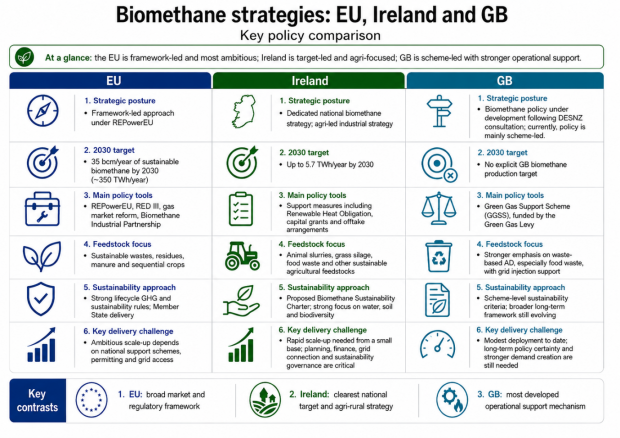
As with other energy vectors, such as electricity, the development of a biomethane industry will also be affected by neighbouring jurisdictions. Cross-border trade arrangements8 and the regulations that producers need to comply with in other markets are important, generating both opportunities as well as barriers. If priced competitively biomethane and associated co-products produced locally could be sold in GB, Ireland or into Europe providing revenue streams to suppliers. An overview of the different approaches to biomethane in these jurisdictions is shown in Figure 3 below.
Biomethane production in Northern Ireland call for evidence 2024 summary
DfE previously issued a call for evidence on the production of Biomethane in May 2024 which closed in August of that year. The Call for Evidence (CfE) sought information and views on the role of biomethane in the path to net zero, sustainable feedstock management, economics of biomethane and gas network connection costs.
The analysis of the responses to this consultation exercise was published in April 20259. Key conclusions from the report were:
- A strong interest in developing a local biomethane sector however no consensus was identified on its primary role (e.g. hard to abate sectors).
- While a production target would help market confidence it would only be credible if it was both practical and sustainability led.
- Feedstock policy should be a central consideration. This includes the use of grass silage which was considered politically and environmentally sensitive.
- While slurry separation with solids redirected to AD was widely supported it was not considered to provide a complete nutrient solution. Hence AD alone is insufficient to solely address on farm nutrient excess problems.
- The economics remain uncertain and need better real-world evidence of sustainable revenue generation within the regional context.
- Unsupported biomethane is unlikely to develop at scale under current market conditions and support mechanisms are needed to provide price or output certainty. Consumer impacts are a major constraint with concerns raised on how the sector could be sustained longer-term.
- High Alignment on Agricultural Cooperative Operating Models to share benefits and enhance buy-in from the underpinning sectors.
- Network connection costs, planning delays and cross-government coordination remain as critical delivery barriers.
Interdepartmental Biomethane Group (IDBG)
The IDBG was established in 2021 to bring together stakeholders from across the biomethane sector. It was refreshed at the end of 2025 to have a focus on the development of biomethane policy for consultation. The group has been chaired by the Centre for Advanced Sustainable Energy (CASE) and has representation from DfE, DAERA and the Utility Regulator.
Energy, Nutrient and Carbon System Services
The above sections highlight the need to take a holistic view and adopt a systems approach which can maximise the potential benefits and minimise the risks when considering growth in the biomethane sector. In essence the energy, economic and environmental aspects need to be addressed together when considering policy.
It is also clear that rural communities are critical to success as is enabling and supporting the wider economy and its critical infrastructure to assure the ecosystem remains nationally and internationally competitive. Any government interventions need to be sustainable and leverage complementary policy to support long-term success.
Given this context this consultation sets out the rationale and proposed design for a regional biomethane policy. It aims to seek views on the likely policy positions of both DfE and DAERA aiming to support a biomethane sector which contributes to decarbonisation, improved air and water quality, and rural economic growth through a coordinated, cross-departmental approach.
Experience from other jurisdictions, stakeholder engagement and scientific research shows that there is a significant opportunity to use a well-designed biomethane strategy to positively impact the convergence of several challenges that face the region. In particular:
- Replacing fossil fuels with regionally produced alternatives.
- Accelerating the decarbonisation of industry and agriculture.
- Training, upskilling and reskilling the workforce for green jobs.
- Addressing nutrient loading pressures and environmental impacts across air and water.
- Revitalising and rebalancing rural economies and increasing the number of good jobs and sector productivity.
This consultation proposes that these pressure points on the local economy and environment can be eased by a systems approach, using circular economy principles and adoption of a combination of complementary technologies and policies aligned to regional strengths.
In turn these system services draw from existing strengths in the regional economy, including the manufacturing, agriculture and services sectors to catalyse wider decarbonised growth and encourage development of new exportable industries.
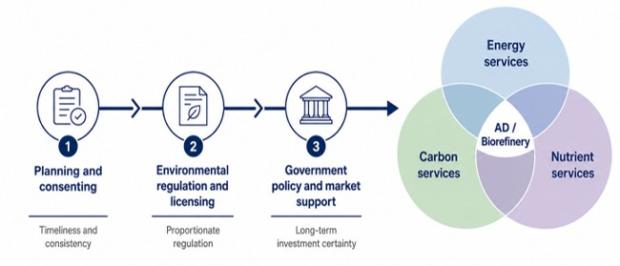
Three system services have been identified which can be summarised as energy, nutrient and carbon.
- Energy system services relate to the role of biomethane as an energy carrier within an overall renewable energy mix e.g. integration with other energy vectors (e.g. electricity), and how AD can work as part of future gas policy to supply greater energy resilience and long-term energy storage.
- Nutrient system services focus on enabling nutrient circularity. This recognises that AD can serve as a point source for nutrient concentration and subsequent processing thereby supporting both agriculture and the environment. As with energy a broader range of options exist including nutrient tracking and the development of digital technologies to support the closure of the nutrient circularity gap.
- Carbon system services span a broad range of products and tools which can utilise by products such as biogenic CO2, biochar to support carbon sequestration, low-carbon construction materials, biofertilisers, e-fuels etc. thereby supporting the Climate Act obligations.
Preferred Policy Position
The preferred policy direction for both DfE and DAERA is therefore to consider biomethane holistically through the lens of the three system services and the mutual benefits that interventions can bring to the wider economy and environment. As such biomethane cannot be considered in isolation and while short to medium term interventions are proposed to support the development and growth of the biomethane sector these interventions must consider the longer-term need and opportunities.
Question 1: Do you agree that the three system services (Energy, Nutrient and Carbon) give sufficient scope to develop cross cutting policy which can support the biomethane and associated sectors whilst protecting the long-term interests of the environment and economy? Strongly agree Agree Neither agree nor disagree Disagree Strongly disagree You may wish to explain your answer or provide any additional comments. |
Beyond biomethane - Enabling revenue stacking and biorefinery support
Increasingly, biomethane is only one of several potential income streams for an AD plant. While provision of nutrient recovery services and valorisation of waste streams into products introduces extra costs for additional plant and operations, it also spreads the core AD plant cost base across multiple product lines and reduces dependency on a single income stream.
During the initial rounds of stakeholder engagement for this consultation, some AD operators and developers indicated that they already were producing additional product lines from their AD operations and were considering additional investment when markets developed. These focused on:
- BioCO2: This market is already established and growing in areas such as food and beverages (e.g. packaging, carbonation), greenhouse cultivation, clean manufacturing and e-fuels (e.g. green chemicals, e-fuels such as e-methanol and e-SAF). Applications such as sequestration of bioCO2 for carbon credits have also been explored.
- Biochar: There has been significant local interest in biochar as an additive to soils and concrete. In the latter, biochar made from AD digestate where cattle slurry and grass silage were the principal feedstocks, has been of interest due to the high silica content which can strengthen concrete while lightweighting the final product.
- Biofertiliser: Local businesses are already supplying a significant fraction of the region’s fertiliser needs based on processing of current supplies of AD digestate. Recent geopolitical events have shown how easy it is to disrupt and raise costs for imported fertiliser much of which could be replaced using local feedstocks and by transferring nutrients from areas of surplus to farmland where needed.
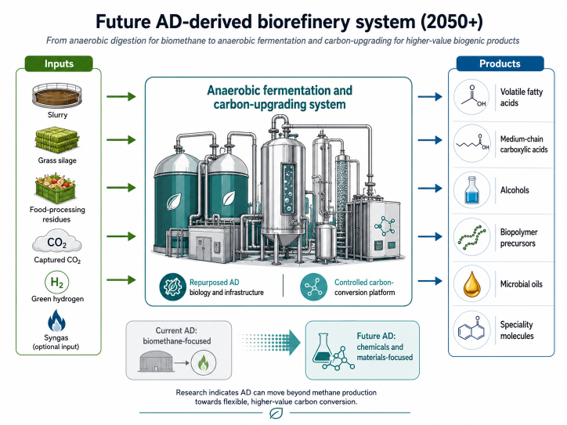
Adopting the right policy enables a future biomethane sector to support market development as well as catalyse the development of a longer-term biorefinery operation, resulting in positive benefits on rural communities including high value jobs in a growing, sustainable sector. These facilities would likely evolve from initial biomethane investments and go beyond the above nutrient recovery services co-products such as bioCO2, biochar and biofertiliser.
The UK biorefinery policy is primarily driven by the Biomass Strategy 202310, which outlines the UK government's approach to using sustainable biological resources to reach net-zero by 2050. The more recent Irish bioeconomy consultation states “The development of Ireland’s bioeconomy can help convert [biological] resources into higher-value products including new sources of food and feed, biobased chemicals, biomaterials, and bioenergy. In doing so, the bioeconomy can create new value chains that diversify farm, rural, coastal and regional incomes, support indigenous enterprise development and contribute to decarbonisation, defossilisation and Ireland’s wider industry, climate and environmental targets, while strengthening competitiveness, energy and resource security.” 11
Specific actions seek to maximise the utilisation of established pilot scale biorefinery infrastructure and enhance capacity and capability of sites where necessary and feasible. Other actions also seek to identify potential biorefinery hub pathways to validate technologies and the business models. As such opportunities exist to align biorefinery strategy across the UK and Ireland and position Northern Ireland to benefit.
Preferred Policy Position
The preferred policy direction for both DfE and DAERA is to consider that future biomethane policy and investment should seek to align with the wider bioeconomy opportunity. Both departments will continue to engage with counterparts in neighbouring administrations to promote the potential advantages of a bioeconomy and advocate for local investments.
Question 2: New products from AD waste streams offer an opportunity for current and future AD operators to support growth in the wider bioeconomy. Do you agree that the Biomethane strategy should also support the development of a wider regional biorefinery capability? Strongly agree Agree Neither agree nor disagree Disagree Strongly disagree You may wish to explain your answer or provide any additional comments. |
| Question 3: Which products have the greatest opportunity to support revenue generation alongside biomethane and how can government facilitate market development without direct subsidy? |
A hub and spoke model focusing on heat
Most existing AD plants are focused on electricity generation and were optimised to the NIRO tariff structure leading to smaller sub 500kW electricity units often located away from gas grid infrastructure. With the closure of the NIRO to new entrants and no new equivalent these facilities are likely to require changes to remain operational once the NIRO revenue stream ends.
Similarly, these existing plants generally do not have nutrient processing facilities directed to export markets instead relying on landbanks to provide that service. At the same time, it is recognised that it is often cheaper to expand and maintain existing assets rather than build new capacity.
Therefore, while a focus on new larger-scale centralised AD plants with additional processing capabilities offers advantages in terms of economies of scale including grid connectivity and digestate management, the overall capital cost is expected to be higher in terms of investment per m3 of gas produced relative to expansion of the existing decentralised asset base. A hub and spoke model with a central hub where smaller scale AD plants transported digestate for nutrient recovery and processing into products as well as transferring compressed and partially cleaned biogas for upgrading to biomethane and gas network injection offers a practical and acceptable alternative for business to develop. In either case, any business models will need to be able to sustain local farming communities and deliver multiple system services.
The potential for such a hub and spoke model to support NAP compliance has been recognised in the NAP (2027-2030) consultation. Co-operative ownership of the centralised assets was also highlighted in the DfE consultation responses.
Hence a hub and spoke model is expected to serve as a pathway which will allow farmers to manage excess nutrient from livestock farming and create additional revenues from the supply of feedstock to facilities. This not only produces biomethane for decarbonisation of the gas grid but also supports the valorisation of other co-product streams to support emerging markets such as organic fertilisers, green ammonia and biochar.
Preferred Policy Position
The preferred position of both DfE and DAERA is to encourage the hub and spoke model where this is practical and advantageous. Centralised facilities are expected to lower the costs associated with nutrient management and export as well as gas clean up and grid injection. They are also expected to be better positioned to serve as energy balancing facilities to support the wider energy system. Decentralised facilities should where practical, continue to support on-farm requirements and provide additional revenue to farms via the production of biomethane and other co-products.
It is expected that this strategy will enable existing AD operators to expand production thereby leveraging the existing capital base, skilled workforce and established feedstock supply chains to enable expansion of biomethane supply. Additional, strategic centralised AD systems with additional processing capabilities will also be encouraged where these are advantageous.
Question 4: Subject to planning and grid connection policy do you agree that the proposed approach for a hub and spoke model blending existing and new facilities would help facilitate cost competitive biomethane relative to other markets? Strongly agree Agree Neither agree nor disagree Disagree Strongly disagree You may wish to explain your answer or provide any additional comments. |
Biomethane Price Support
Biomethane is generally more expensive than natural gas requiring either a direct subsidy to compete with cheaper alternatives, or where internal or external mandates necessitate its use, for example company policy or legislated obligations
In England, Scotland and Wales the Green Gas Levy (GGL) which was established in 2021, is a mandatory environmental charge on licensed fossil fuel gas suppliers. This levy funds the Green Gas Support Scheme, which incentivises the production of renewable biomethane for injection into the national gas grid. Ireland however intends to use the Renewable Heat Obligation (RHO) which requires fossil fuel suppliers to include a rising percentage of renewables, such as biomethane in their energy mix.
Both schemes present difficulties to local consumers when considering biomethane support. Locally heat is still predominantly from oil meaning that any levy or obligation imposed only on fossil gas suppliers will disproportionately impact gas users thereby potentially encouraging consumption of more carbon intensive fuels. Based on research data2 the biomethane proportion in the NI grid is also likely to be significantly higher than that of the GB grid thereby exacerbating the issue.
The position of DfE is not to introduce a levy or obligation at this stage. Instead, interventions which could support the sector over the near term and draw from existing schemes are preferred.
The non-domestic RHI scheme closed in June 2026 and is expected to result in an underspend of the Annually Managed Expenditure (AME) funding until 2035. This funding is ultimately controlled by HM Treasury and must be spent on “a scheme to facilitate and encourage renewable generation of heat in Northern Ireland” as per Section 113 of the Energy Act 2011. Treasury has agreed that in principle the underspend could be used for a non-domestic biomethane support scheme, subject to the approval of a business case.
The main considerations for how to use the residual AME funding are therefore:
- Providing renewable heat to industry through biomethane to help with decarbonisation and business competitiveness;
- Alignment with the original scheme intentions with strict caps on spending to stay within a defined budget;
- Maximising the benefits of the funding before 2035;
- Supporting regional balance.
It is recognised that greater long-term market certainty is required to attract the investment required to fully develop an AD industry. Future policy development will consider further steps alongside consideration of the benefits and costs of greater energy security, decarbonisation of the gas grid, inter-seasonal energy storage, dispatchable power and utilisation of AD to provide a pathway for region wide nutrient management.
Preferred Policy Position
DfE’s preferred position is to develop a limited scheme which can support the use of biomethane for industrial heat decarbonisation. The biomethane would be subsidised with AME funding with a p/kWh subsidy and a cap on the biomethane volume and price to maintain the scheme within the budgetary envelope (approximately £13m/annum). The biomethane would need to be certified to enable accounting in scope 1 emissions, and available for delivery within the support window. This is still subject to business case approval including an evaluation of options and should not be taken as a final position.
Question 5: Do you agree with the proposed use of residual AME funding to support biomethane? Strongly agree Agree Neither agree nor disagree Disagree Strongly disagree You may wish to explain your answer or provide any additional comments. |
Question 6: Given the level of funding and timelines, which style of support scheme do you think the residual AME funding should be used for? You may wish to explain your answer or provide any additional comments |
Nutrient recovery and AD feedstocks
Achieving the dual policy goals to deliver increased levels of biomethane and create a viable route for nutrient recovery requires an expansion of AD in conjunction with nutrient and ammonia recovery from digestate. Synergies with the NAP (2027-2030) consultation suggest that minded to position will support a biomethane sector having the following nutrient support features:
- Mass-balance accounting
Verified nutrient statements showing tonnes of slurry/digestate exported, laboratory-tested N/P/K content, recovered nutrient fractions, and net nutrients removed from the farm-gate balance.
- Accredited processors
Nutrient recovery facilities approved or accredited, with standardised sampling, weighing, nutrient analysis and reporting. - Recognition in NAP compliance
Exported slurry solids, recovered phosphorous and nitrogen, dried digestate, struvite, calcium phosphate, biochar-based fertiliser or other products could count as nutrient exports only where there is auditable evidence of removal from the farm and legitimate onward use. - Catchment-sensitive deployment
Nutrient recovery will be prioritised in high-P catchments, intensive dairy and beef areas, pig/poultry clusters and land draining to Lough Neagh, Lough Erne, and other sensitive waters. - Clear rules for digestate
Digestate will not be treated more favourably than slurry to avoid AD becoming a loophole that increases slurry movement without reducing nutrient pressure. - End-market development
Recovered nutrient products must show real outlets: arable regions, horticulture, forestry establishment, land restoration, peat-free growing media, export markets, replacement of imported mineral fertilisers or capture in other products such as biochar. This is essential as recovery will not be successful long-term if nutrient products accumulate in storage with no end-use.
Implementation of nutrient recovery technologies in other jurisdictions, discussions with AD operators and developers as well as academic research indicates that nutrient recovery technologies for ammonia, phosphorous and nitrogen are mature and economically feasible to operate. Markets already exist and are growing for key co-products - a key requirement for economic viability being that sufficient feedstocks are available at a price that supports competitively priced biomethane production.
While AD and complementary technologies which support nutrient recovery are expected to deliver net environmental benefits relative to existing practice it is also recognised that whole slurry AD systems are unlikely to be cost competitive relative to systems which operate on a blend of feedstocks.
The potential for the enhanced AD/biorefinery system to support the harvesting and mining of nutrient from landbanks is an important consideration. Hence while there are legitimate concerns linked to the ‘food vs fuel’ debate and while the previous DfE consultation highlighted sensitivities to the use of feedstocks including grass silage it is recognised that the optimum environmental and economic outcomes will necessitate usage of a blend of feedstocks.
Preferred Policy Position
While this consultation does not seek to develop new policy in terms of feedstock it does recognise that the recent NAP consultation enables landowners to balance nutrient loading to outputs. Hence while it does not include new nutrient recovery policy it does highlight that the NAP consultation offers mechanisms whereby farmers can recover and manage nutrients with verification leading to potential additional income via the proposed Biomethane strategy. Feedstocks include energy crops such as maize, excess silage or other biogenic residues could in effect allow farmers and processers to benefit from additional revenue where production is nutrient balanced.
Question 7: Do you agree that government should encourage the use of blended feedstocks which support optimisation of future AD systems for the benefit of the region? Strongly agree Agree Neither agree nor disagree Disagree Strongly disagree You may wish to explain your answer or provide any additional comments. |
Network Connection Costs
The current “producer pays” model for gas network connections for biomethane injection means producers must fund their own connection costs and any wider network reinforcements12 necessary to accommodate their connection. This has created a “first mover pays” issue as the first connecting producer in an area is required to pay for all network reinforcements which later producers may benefit from without contributing to the initial costs.
Responses to the Department’s 2024 Call for Evidence highlighted this as a major issue with a majority supporting ‘socialising’ or spreading costs associated with connecting to the network, particularly for strategic network infrastructure. This would mean spreading these costs across all gas consumers over a defined period through network tariffs. This approach is used in neighbouring jurisdictions, for example, in Great Britain Ofgem offers capped funding support for connections under its price control, while in the Republic of Ireland there is a hybrid approach where producers pay 30% and the remainder is spread across consumers, subject to an economic test and financial safeguards.
The Gas Network Operators (GNOs) commissioned a report that modelled the technical, infrastructure, and regulatory options for dealing with the potential constraints that could arise from using more biomethane in the local gas network. It also analysed the impact of spreading the costs of funding these options. This work was further scrutinised by DfE and the Utility Regulator. The Department identified a range of options for addressing the costs of biomethane network connections - maintain the current policy; spread costs of essential network level reinforcement costs only; spread the cost of essential network level reinforcements and 30% of direct producer pipeline connection costs and spread the cost of essential network level reinforcements and all direct producer pipeline connection costs.
Preferred Policy Approach
The Department proposes to spread the cost of essential network level reinforcement costs only required to facilitate biomethane producers connecting to the transmission or distribution network across all gas consumers. This means that producers will still be responsible for their direct connection costs to the gas network. These network level reinforcements will be able to benefit several producers and will be situated in strategic locations. This will require coordination between producers, gas network operators and the Utility regulator to identify and justify essential network level reinforcements and as such no particular type of technology is being ruled out at this stage. Costs for essential network level reinforcements would include both the CAPEX13 and annual OPEX.
To ensure the impact on consumer bills is limited, a high-cost cap will be implemented. For example, this could take the form of a cost cap on infrastructure spend by project or on the amount consumers are being asked to pay or both. An overall cap on the amount consumers will be asked to pay in any one period is proposed as a minimum to provide protection for consumers. A form of user commitment is also being explored at this stage. The policy will be reviewed periodically to ensure it is providing value for money.
This option would remove the financial cost of essential network level reinforcement costs and the “first mover pays” issue associated with the current policy and could encourage greater connection and injection of biomethane into the gas network. It would support appropriate infrastructure that could benefit a range of producers whilst also ensuring that gas consumers are not heavily impacted. There will be controls in place to ensure that there are system-wide benefits and value for money. This encouragement of the biomethane sector could also bring both economic and environmental benefits to the region through the creation of goods jobs in rural areas, promoting regional balance, and contributing to decarbonisation goals. This option is seen as a suitable balance between supporting biomethane network connections, minimising the risk of stranded assets and protecting gas consumers.
Further details of the assessment and the rationale for the preferred policy position can be found in Annex A.
Question 8: Do you agree with the proposal for the socialisation of strategic biomethane connections to gas consumers subject to a cost cap of some form? Strongly agree Agree Neither agree nor disagree Disagree Strongly disagree You may wish to explain your answer or provide any additional comments, including the cost threshold. |
Gas Quality (Permissible Oxygen Limits)
The Department’s 2024 CfE identified gas quality, specifically permissible oxygen content in gas entering Northern Ireland’s (NI) gas networks, as an issue for the development of the biomethane sector and its use in the gas networks. Biomethane has a higher oxygen content than natural gas so requires specific measures to ensure infrastructure is not damaged.
To inform policy development, the local transmission system operators (TSOs) undertook a call for evidence with industry stakeholders. This exercise sought views on appropriate oxygen limits across transmission and distribution systems, considering economic viability, operational and safety implications, and cross-border gas flows.
The results of this call for evidence and the Department’s analysis, have informed the development of a new policy position for permissible oxygen limits. The assessment of responses to the call for evidence and rationale for the below policy position can be found in Annex B.
Preferred Policy Position
Based on the evidence gathered and analysis undertaken, the Department has identified the following policy position centred on network harmonisation, risk management, and support for biomethane deployment:
- Increase the permissible oxygen limit on the transmission system from 0.2% to 0.5% (molar);
- Reduce the permissible oxygen limit on the distribution system from 1% to 0.5% (molar), ensuring alignment across both network tiers.
By harmonising oxygen limits at 0.5% across both transmission and distribution networks, the Department aims to unlock biomethane potential, support future network flexibility, and maintain system safety and reliability. This approach also ensures alignment with regional developments and provides a pragmatic foundation for future evolution of the gas system, including the potential integration of hydrogen.
Question 9: Do you agree with the proposed policy that permissible oxygen limits should be revised ensuring alignment across both network tiers? Strongly agree Agree Neither agree nor disagree Disagree Strongly disagree You may wish to explain your answer or provide any additional comments. |
Propane enrichment of biomethane before gas-grid injection
Biomethane produced by anaerobic digestion is chemically close to natural gas, but it is usually a leaner gas with a lower calorific value (CV) as it contains mostly methane, with small residual amounts of CO₂, nitrogen, oxygen and trace contaminants. Because gas billing and gas-safety regimes were designed around fossil natural gas, biomethane projects have often had to add propane before grid injection. This raises the CV and helps the injected gas conform with the gas-quality and billing arrangements used on the distribution network.
Compulsory propanation is increasingly seen by the AD industry as an unnecessary cost burden on biomethane producers and a poor fit for net zero. It adds fossil carbon (propane), cost, complexity, safety obligations, LPG logistics and additional embedded emissions. Removal of the requirement would be a significant cost saving representing around £7-9 MWh14 resulting in lower prices for biomethane and reduced carbon emissions.
However, gas quality rules exist for good reasons such as safe appliance combustion, fair billing, industrial process stability, and confidence for large gas users and power generators. Gas entering the distribution network must behave safely and predictably in domestic boilers, industrial burners, gas engines, turbines, meters and billing systems. This is less of an issue at transmission level as the biomethane is being injected into a larger gas stream.
When natural gas is distributed to customers it has a CV and Wobbe Index within defined ranges. The requirements are set out in the Gas Safety (Management) Regulations (Northern Ireland) 1997, whose Schedule 3 sets the permitted content and characteristics of gas in the network.
However, injection of biomethane offers additional complications. As biomethane would be most likely injected at multiple different points on the transmission and distribution grids, modelling would have to be undertaken to determine the degree of mixing and homogenisation of the biomethane/natural gas mix. Good homogenisation would give a consistent CV that would be within current regulatory requirements for likely total biomethane injection to the gas grid over the next 10+ years.
The difficulty comes when biomethane is injected into the distribution network at significant volumes such that local gas users get all or a substantial amount of their gas from the injected biomethane and homogenisation does not occur. This should not have material effect on boiler functioning for domestic consumers but the drop in CV will affect accurate billing for energy content to all consumers using simple flow metering.
Preferred Policy Position
The preferred policy is to move away from the propanation requirement in the longer term and allow non-propanated biomethane where safety, network blending, metering and billing are demonstrably robust.
Question 10: Do you agree with the longer term move away from the use of gas propanation? Strongly agree Agree Neither agree nor disagree Disagree Strongly disagree You may wish to explain your answer or provide any additional comments. |
Biomethane Certification
Biomethane is not only a carbon-reduction pathway but also a nutrient-management and catchment-recovery tool. As such, certification of biomethane production needs to be able to reflect the sustainable nature of production and the environmental benefits accrued during the production process. The desire is also to ensure that biomethane produced and certified locally is compliant with current and future UK and EU requirements for offsetting carbon taxes by businesses.
This requires a biomethane assurance framework that is consistent with and at least equivalent to established standards and schemes. Currently, there are two broad categories of certification for biomethane Guarantees of Origin (GOs) and Proofs of Sustainability (PoS) which serve different purposes15. In the UK, Guarantees of Origin are generally referred to Renewable Gas Guarantees of Origin (RGGOs) and Certificate of Origin (CoO) under an umbrella scheme for various national certificates operated by the European Renewable Gas Registry16 (ERGaR).
- RGGOs are mainly voluntary market instruments: they allow biomethane injected into the gas grid to be matched with gas consumption elsewhere, enabling green gas claims by suppliers and end-users for ESG purposes. They are generally not recognised for carbon taxation purposes (ETS and CBAM) and have no impact on national GHG accounting. RGGOs are certificates issued in the UK by the Green Gas Certification Scheme17.
- PoS documents are sustainability and regulatory-compliance instruments: they evidence that biomethane meets sustainability and greenhouse gas saving criteria, especially under EU Renewable Energy Directive frameworks and EU-recognised voluntary schemes such as ISCC EU, REDcert, SURE and others.
For maximum flexibility and UK/EU market accessibility, biomethane producers need to be able to use RGGOs, or a compatible GOs scheme, for the UK/EU voluntary and supplier market but also be able to supply required EU-recognised, PoS sustainability evidence for biomethane intended for high-value industrial, EU ETS, cross-border, or Ireland/EU-linked markets.
Ireland has been developing its own Gas Certification Scheme18 which recognises the mandatory sustainability requirements from the EU Renewable Energies Directive (RED). Gas Networks Ireland registers and issues certificates to Irish producers that inject renewable gas into the gas network. To be compatible with cross-border trade in biomethane, producers must be able to participate in a recognised equivalent certification scheme to that adopted in Ireland. This will also enable export into European markets that require EU ETS compatibility or similar.
The approach proposed is to follow a dual system with RGGO-compatible certification with PoS-ready requirements. Biomethane producers looking to sell to Europe or to customers offsetting carbon tax obligations would then be in a position to obtain suitable PoS certification. The proposed route is similar to the requirements for the Green Gas Support Scheme in GB where biomethane producers must fulfil sustainability requirements set by Ofgem to qualify19.
The dual approach avoids biomethane being restricted to lower-value voluntary markets and avoids the risk of overburdening small producers with the higher-level PoS compliance costs where not needed. DfE and DAERA will undertake further discussions with RGGO and PoS certifiers to ensure that biomethane can be certified in relevant markets.
Preferred Policy Position
DfE and DAERA recognise that future certification will:
- Require every subsidised or supported biomethane unit to have a unique origin certificate, compatible with RGGO-style trading and retirement.
- Require robust sustainability data at source, aligned as far as practical with RED/ISCC-style PoS data fields: feedstock type, waste/residue classification, land criteria, lifecycle GHG intensity, methane leakage assumptions, digestate management and chain of custody.
- Allow optional or mandatory PoS certification for higher-value markets, especially where the buyer is in Ireland, the EU, EU ETS, FuelEU Maritime, transport fuel compliance, public procurement, or for large corporate net-zero reporting.
- Prevent double counting between RGGO and PoS claims.
Where a GO/RGGO and PoS have been issued for the same biomethane consignment, they cannot be traded separately to different companies. - Ensure that certificates are interoperable with Ireland’s emerging gas GO framework.
Currently, there are several recognised PoS schemes all of which have different sustainability criteria. If future NAP compliance requires nutrient tracking at farm or catchment area level, then it is likely that whichever existing scheme is adopted may need to be extended with a nutrient-safe biomethane module to cover specific nutrient management requirements.
Question 11: Do you agree with the proposed dual approach to biomethane certification and that DfE and DAERA need to ensure the certification of biomethane supports regional growth? Strongly agree Agree Neither agree nor disagree Disagree Strongly disagree You may wish to explain your answer or provide any additional comments. |
Measurement, Reporting and Verification
Measurement, Reporting and Verification (MRV) of nutrient flow is integral to nutrient management and payments. Nutrient MRV services will include measurement, validation and reporting on farm, at AD operators/nutrient service providers and at point of export or permanent removal from agriculture. Nature-based solutions such as tree planting, buffer strip creation or drainage lagoons may also qualify subject to approved models and measurement of the effectiveness of nutrient capture. Data sets including digital twinning and soil nutrient health can be used to quantify the nutrient reduction in fields with only verified reductions receiving an additional payment. Rebalancing of imported nutrients (feed, fertiliser) and exported nutrients (exported products, animal wastes) can be used as a mechanism to optimise efficiency and manage performance.
Preferred Policy Position
Within the NAP reporting and verification are required to track organic manure and digestate movements. The Department’s position is that going forward robust systems are needed to support nutrient traceability.
Question 12: Do you agree that Measurement, Reporting and Verification methods are critical to assuring system credibility and should be standardised as well as support certification? Strongly agree Agree Neither agree nor disagree Disagree Strongly disagree You may wish to explain your answer or provide any additional comments. |
This marks the conclusion of the consultation questions. The annexes that follow provide supporting information and further detail on connection costs and gas quality issues.
Annex A - Network Connection Costs Position Rationale
Background
The current “producer pays” approach for new gas network connections requires the biomethane producer to fund their direct connection costs and the full cost of any necessary network reinforcements triggered by their connection. This places a significant financial cost on producers seeking to connect to the network. It has also created a “first mover pays” issue, as the first producer connecting to the network is required to fund the full cost of any network reinforcements, which are then used by others who subsequently connect in the same area. This places the full financial cost on the first producer, as subsequent connections are not required to contribute to those initial reinforcement costs.
The Department’s 2024 CfE identified the cost of connecting biomethane producers to the gas network as a key barrier, noting that in other regions, such costs are often shared with gas network operators (GNOs).
A majority of responses (61%) supported socialising or spreading at least some connection-related costs, particularly for strategic investments like reverse compression and injection hubs. Some suggested hybrid models where capital costs are borne by producers, but operational and maintenance costs are shared. However, 21% opposed spreading any costs, citing concerns about burdening consumers. ‘Socialising’ these costs would mean spreading these costs across gas consumers over a period of time through network tariffs.
Given the complexity of cost allocation and its implications for industry development, respondents recommended that DfE conduct a detailed review in collaboration with stakeholders before finalising policy decisions.
Connection costs policy in neighbouring jurisdictions
In GB, Ofgem’s most recent price control RIIO-3 has provided funding to reduce the costs associated with connecting to the gas networks and encourage more producers to connect. The regulatory framework for National Gas Transmission, proposes reimbursing biomethane producers for capex and opex costs associated with connecting biomethane plants to the National Transmission System20. A ‘Use it or lose it’ (UIOLI) funding mechanism introduced on 1st April 2026 provides £2 million per biomethane connection, capped at a total of £20 million for the RIIO-GT3 price control.
The regulatory framework for Gas Distribution Networks (GDN), contains a similar funding mechanism to address network capacity constraints arising from biomethane entry connections at distribution level21. A UIOLI mechanism introduced on 1 April 2026, provides £2 million per biomethane connection, capped at £4 million annually (unused funding will roll over to the following year) and £20 million across the 5-year price control for each network.
In Ireland, the current connections policy requires producers to pay a standard contribution of 30% of connection costs with 70% of the remaining costs spread across consumers and recovered through network tariffs, subject to an “economic test” to evaluate whether or not the remaining 70% of the connection costs can be recovered through the tariffs paid by the connecting party over the next 15 years. If there is expected to be a shortfall in that tariff revenue, the connecting party must pay an additional upfront supplemental payment to cover the shortfall.
The economic test is based on forecasts of the amount of biomethane that the connecting party will inject into the network and may not reflect the actual delivered volumes. If the forecast is higher than the amount of biomethane eventually injected, then the connecting party will have paid less towards the connection cost than has been reflected in its upfront contributions. To protect consumers and mitigate this risk of a shortfall in revenue or if the asset becomes stranded, the connection policy requires biomethane producers to provide financial security.
In June 2026 the Commission for Regulation of Utilities (CRU) extended the economic test appraisal period from 10 to 15 years and implemented a new phased approach to financial security. Financial security is now phased across construction and operational stages, with financial security required to cover all socialised capex costs during the construction phase22, and then 70% of the socialised proportion of the cost of building the connection during the operational phase. The requirement will then reduce in line with tariff revenue associated with the injected gas until the cumulative revenues cover the 70% of the socialised upfront costs.
Network Constraints Project
The Gas Network Operators (GNOs) used Energy Strategy Funding to appoint consultants to analyse the potential constraints that could arise from more biomethane connections to the local gas network and how these connections could be accommodated. There were three key work packages:
- Technical Review – A review of the technical benefits/challenges of the potential options to alleviate network constraints of accommodating biomethane connections to the networks.
- Infrastructure Planning – In collaboration with NI GNO staff, develop an optimal infrastructure plan to alleviate projected near and medium-term network constraints in Northern Ireland.
- Regulatory Review – Review the regulatory implications of the potential options and develop a regulatory workplan to enable the proposed optimal infrastructure plan.
The project culminated in detailed, evidence-based reports to inform policy and investment decisions by the NI GNOs, the Department for the Economy, and the Utility Regulator. The project modelled several scenarios to identify the most cost-effective strategy for connecting potential AD plants, identified in the GNOs 2024 Request for Information, to the gas networks to alleviate network constraints and facilitate biomethane injection, alongside how these costs could be spread. The input costs for connecting biomethane producers to the network used in the project, were further scrutinised by the Utility Regulator through external consultancy.
Policy Options for network connection costs
Following review of the evidence base gathered through the network constraints report and wider analytical research, the table below sets out the options considered for funding gas network connection costs for biomethane producers connecting to the network.
Options for biomethane network connection costs
| Option 1 | Status quo – remaining with the current connection policy. The current “Producer pays” approach would remain, meaning biomethane producers wishing to connect to network would be responsible for all pipeline and necessary reinforcement costs to facilitate their connection. |
| Option 2 | Spread the cost of essential network level reinforcements only. Any essential network level reinforcements to facilitate biomethane network connections will be spread across gas consumers. This could include reinforcements such as:
Costs for reinforcements would include both the CAPEX and annual OPEX for essential network reinforcements required to facilitate the biomethane connection. This will require coordination between producers and gas network operators to identify areas for connection and justify essential reinforcements. The key principle here is that only reinforcements that provide system-wide benefits will be considered. |
| Option 3 | Spread the cost of essential network level reinforcements and 30% of direct producer pipeline connection costs. In addition to essential network level reinforcements as above, 30% of the pipeline CAPEX to connect the producer to the network would also be spread across gas consumers. |
| Option 4 | Spread the cost of essential network level reinforcements and all direct producer pipeline connection costs. All network reinforcement and pipeline CAPEX costs associated with connecting a biomethane producer to the network would be spread across gas consumers. This could include:
|
| Controls | Options 2-4 would each include a High-Cost Cap and a potential user commitment requirement. This will help to manage the effect of costs on consumers, deter costly and inefficient requests, and prevent stranded assets. |
Assessment of options
Factors considered when assessing options were:
- Ability to support the development of the local biomethane sector.
- Addressing the “first mover pays” issue and increase the amount of biomethane injected into the gas network.
- The potential benefits of biomethane that are shared across society e.g. reduced carbon emissions, improving energy security, and reducing the use of fossil fuels.
- Whether interventions are proportionate and can bring system wide benefits.
- The risk of stranded assets, i.e. building infrastructure that is not needed in the longer term.
- The impact on gas consumers.
Status quo – remaining with the current connection policy
This option would have the least cost to the consumer, as no connection costs would be spread across gas consumers and would minimise the risk of any stranded assets. This option would not address the “first mover pays” issue as they would still be responsible for any network investment costs triggered by their connection. The current policy could continue to act as a significant financial barrier to producers, hindering development of a coordinated biomethane sector across the region and limiting the potential economic and environmental benefits.
Spread the cost of essential network reinforcements only
The need for network level reinforcements to accommodate biomethane connections is because the majority of biomethane production in NI is expected to take place either in or near rural areas, as production will be primarily fed through agricultural feedstock. However, the rural gas distribution networks are limited by how much they can accommodate the injection of significant volumes of biomethane, and not all producers will have connections to the gas network. As such, network level reinforcements such as distribution ‘zone to zone’ pipeline connections, reverse compression between network tiers or CGI hubs at transmission level could be necessary to accommodate the injection of biomethane.
Spreading the cost of essential network level reinforcements would remove the financial barriers resulting from the ‘first mover pays’ issue, as the first connecting producer would no longer be responsible for funding essential network reinforcements which are then used by other producers who subsequently connect in the same area. Removing this financial barrier could facilitate the connection of biomethane producers to the gas network and/or encourage the injection of biomethane. Spreading these costs would ensure that no single producer faces this unfair financial cost for being the first to connect in an area and would better facilitate market entry by producers aiming to connect to the network. Whilst it could be argued that all producers wishing to connect to the network should contribute to initial reinforcement costs, this would be a difficult approach to implement in practice as connections to the network would be staggered over time with demand potentially increasing as the sector develops, meaning it would be difficult to apportion these costs equally among producers. Additionally, as any reinforcements would become part of the gas network, and therefore owned and operated by GNOs, it could be seen as part of the routine obligations on GNOs to provide network capacity and related costs should therefore be spread across gas consumers. The annual OPEX for reinforcements would also be burdensome to producers and may also be challenging to recharge producers in practice, particularly in areas where reinforcements such as reverse compression may serve multiple producers which costs would need to be attributed across.
Supporting biomethane injection into the network can deliver economic, environmental and agricultural benefits. It could create jobs across the biomethane supply chain in rural communities, through investment in biomethane production concentrated in rural areas, helping to promote greater regional balance across NI. Environmentally, biomethane can act as a direct replacement for natural gas and can help to support the decarbonisation of the gas network and hard-to-electrify industrial processes which utilise natural gas, contributing to our net zero targets and security of supply.
This approach could also enable more strategic network planning by shifting decision-making from individual biomethane producers to a process where individual connection applications can be considered in a coordinated way. Under the current “producer pays” model, connection choices and associated reinforcement investments are fragmented and rest with the first mover, with connection decisions focused on providing the lowest cost to the initial connecting producer without consideration to the most cost optimal solutions for the subsequent biomethane connections and network as whole. By contrast, a more coordinated approach would allow reinforcement decisions to be planned centrally to serve multiple producers, optimise connection locations, optimise the type of infrastructure (to avoid stranded assets), coordinate across networks, and phase infrastructure efficiently, delivering lower overall system costs, and a more coherent approach to accommodating biomethane at scale.
Spreading the cost of essential network level investments is seen as a reasonable approach as they will bring system wide benefits, remove the financial barriers associated with the ‘first producer pays’ principle.
As noted above, a cost cap is proposed on the amount of costs which will be socialised to consumers. It is therefore unlikely that every AD connection can have network reinforcement costs subsidised where these are triggered by their project. A process for assessing connection applications in a more coordinated way will need to be developed. The process will consider the location of ADs as location drives network reinforcement costs and benefits.
Spread the cost of essential network level reinforcements and 30% direct producer pipeline connection costs.
Spreading the cost of a proportion of the pipeline capex, where producers connect directly to the network, would provide producers with additional financial support and further encourage producers to connect. Providing support with pipeline capex costs would not be unprecedented, as this is provided in other jurisdictions e.g. Ireland or France. As discussed above, supporting the development of the biomethane sector and its injection onto the network can bring both economic and environmental benefits to NI and providing further support to the producer’s direct pipeline costs associated with connecting to the network could further encourage investment in the sector and connection to the network.
However, this additional support would not have the purely system-wide benefits that essential network level reinforcement brings e.g. ability to move gas around the networks. Additionally, whilst producers’ pipeline costs may be supported by other jurisdictions and socialisation of such costs could encourage greater investment in the biomethane sector, it is important to consider the increased impact on gas consumers. As option 2 addresses the ‘first mover pays’ issue, any further support must be justified to warrant spreading these costs across gas consumers. NI has a much smaller gas consumer pool to spread costs across in comparison to other jurisdictions, meaning increasing the costs spread across consumers could have a disproportionate impact on NI gas consumers compared to other jurisdictions. It is worth noting that in the instance where a CGI hub is used to connect producers to the network, pipeline capex would not be applicable to producers.
Spread the cost of essential network level reinforcements and all direct producer pipeline connection costs.
This option would provide biomethane producers with maximum support to connect to the network. By removing all costs associated with network reinforcement and all direct producer pipeline connection costs, this approach would promote the greatest level of biomethane connections and investment in the sector, further promoting the economic and environmental benefits that biomethane production can bring to NI.
Whilst this approach would provide the greatest level of support for producers, it could be an unprecedented approach in comparison to other jurisdictions and could incentivise costly/inefficient connections. These costs would also come at great expense to gas consumers and it would be hard to justify this approach to spread this across gas consumers, particularly when the ‘first mover pays’ issue has been addressed.
As a result, option 4 is not seen as a viable approach to spreading the costs of biomethane network connections.
Conclusion
Following the assessment above, the preferred policy position is Option 2 - spreading the costs of essential network level reinforcements only. This option would remove the financial impact of reinforcement costs and the problematic ‘first mover pays’ issue associated with the current policy. It would encourage greater coordination in the connection and injection of biomethane into the gas network and could also bring both economic and environmental benefits to NI through the creation of good jobs in rural areas, promoting regional balance, increasing security of supply and contributing to decarbonisation goals. Whilst options 3 and 4 would provide greater levels of support for producers wishing to connect to the network, these options would have too great a financial impact on gas consumers.
Option 2 is seen as a suitable balance between protecting consumers, preventing stranded assets and supporting biomethane network connections.
Next Steps
The Department will work with the Utility Regulator, Network Operators, and wider stakeholders to progress the preferred position.
As noted in the options table above, a high-cost cap and potential user commitment requirement will be implemented alongside this policy to manage the effect of costs on consumers, deter costly and inefficient requests, and prevent stranded assets. The Department will work with the Utility Regulator and relevant stakeholders to determine the total cost cap, alongside the size of any potential user commitment that may accompany network connections.
Annex B – Gas Quality (Permissible Oxygen Limits) Assessment
Background
The high-pressure gas transmission network is owned and operated between Mutual Energy Limited (MEL) and GNI (UK). This provides the backbone through which gas is transported to lower pressure distribution networks, as well as large energy users, including NI’s gas-fired power stations. The transmission network is physically connected to the networks in Great Britain (GB), via the Scotland to Northern Ireland Pipeline (SNIP) which facilitates importing natural gas from GB, and the Republic of Ireland (RoI), via the South North Pipeline (SNP) which facilitates importing natural gas from GB via RoI.
There are three lower pressure distribution networks to which the transmission network transports gas. These networks are owned and operated by Phoenix Energy, Kinecx Energy, and Evolve.
Current Policy Position
Currently, the local distribution networks permit up to 1% (molar) oxygen content following the introduction of a Class Exemption by Health and Safety Executive Northern Ireland (HSENI) in 202223. The HSENI has recently consulted on formalising the 1% limit and incorporating it as part of changes to the Gas Safety (Management) Regulations (Northern Ireland) 1997 (GSMR NI 1997)24.
However, in accordance with the GSMR NI 1997, only up to 0.2% (molar) is presently permitted on the local transmission system. As biomethane typically has a higher oxygen content compared to natural gas, it may not always be feasible for biomethane producers to meet the current oxygen limit of 0.2% (molar) for entry into the transmission system.
Policy in Neighbouring Jurisdictions
- Republic of Ireland (RoI):
An amendment has raised the maximum permissible oxygen content in the Irish transmission network to 0.5% (molar) from the current 0.2% (molar)25. The rationale for this increase is to facilitate the injection of more biomethane into the gas network, given its higher oxygen content.
For the Irish distribution network, the maximum permissible oxygen content is 1% (molar), the same as that currently in place for the NI distribution networks.
- Great Britain (GB):
In GB, the current maximum allowable level of oxygen in gas flowing in the National Transmission System is limited by Regulation 8(1) of the Gas Safety (Management) Regulations 1996 to no more than 0.2% (molar)26. This is the same as that currently in place for the NI transmission network.
For the GB distribution networks, a ‘class exemption’ granted by the Health and Safety Executive allows for an oxygen limit of up to 1% (molar) on distribution networks, the same as that currently in place for the NI distribution networks.
TSO Call for Evidence Responses
In 2025 DfE asked the gas transmission system operators (TSOs) to conduct a call for evidence (CfE) to gather views on the level of oxygen content which should be permissible for gas entering the NI gas networks. It sought views on potential changes to the permissible level of oxygen content on both the transmission and distribution systems, including impacts on the economic viability of biomethane; operational and safety implications from any changes; and the implications for gas flows with Great Britain and the Republic of Ireland.
The CfE ran for 14 weeks, with 21 responses received from a range of stakeholder sectors including biomethane producers, producer representatives, Distribution Network Operators (DNOs), and gas-fired power station operators. The responses to this CfE have directly informed the analysis and identification of the preferred options for permissible oxygen limits in this consultation.
The key issues identified from the responses to the CfE were:
- Risks to the operation and maintenance of power user equipment and the subsequent impacts on electricity generation.
- Ensuring alignment of permitted oxygen limits with those in the Republic of Ireland (RoI).
- The cost impacts on biomethane producers for lower oxygen limits at distribution level.
- Harmonisation of permitted oxygen levels between distribution and transmission systems to aid reverse compression.
Assessment of Responses
Distribution Networks
- For distribution level, there was a consensus that lowering the permissible oxygen limits could result in greater capital and operating costs for biomethane production due to the need for further purification and deployment of additional equipment. This was a particular concern at a 0.2% oxygen limit due to the need for costly hydrogen sulphide removal which could render projects economically unviable. However, some producers and producer representatives did note that a reduction to a 0.5% oxygen limit would have less of a material impact compared to 0.2%. It was also noted that a 0.5% threshold would have no adverse impact on the ability to connect or maintain biomethane injection since typical biomethane contains 0.3–0.4% O₂.
- However, it was noted that producers may often operate at a lower value than the maximum permitted oxygen level to cope with fluctuations in oxygen levels and ensure consistent compliance with entry standards, reducing the risk of gas flaring which is both costly and wasteful. Lowering the permissible oxygen limit would reduce the operational band for producers which could reduce the tolerance for fluctuation in oxygen levels and impact the feasibility of injecting biomethane into the distribution networks.
- It was also emphasised that the current limit of 1% oxygen content was granted based on both technical feasibility studies and policy objectives related to decarbonisation and renewable gas integration. Achieving a 0.2% oxygen limit would be technically challenging and financially burdensome, allowing up to 1% oxygen was seen as a pragmatic step to enable biomethane injection. If the purpose of raising the distribution level was to facilitate further biomethane injection, then lowering the distribution level from 1% could be counterintuitive.
Transmission System
- For the transmission system, there was consensus among responses that raising the oxygen limit at transmission level to either 0.5% or 1% would facilitate the use of biomethane in the transmission system and could enable producers to inject directly into the transmission system.
- Some responses informed, based on expert advice, that increasing the threshold to 1% would provide a low asset integrity risk with negligible effects on steel distribution and transmission networks, provided certain quality parameters such as moisture content were monitored and controlled to limit the risk of corrosion.
- However, a significant issue raised for consideration was the potential for increased oxygen limits at transmission level to have negative impacts for end users of the transmission system, such as power generators. Several responses advised that increased oxygen levels on the transmission system may lead to greater materials corrosion and degradation within power station equipment, which will increase the risk of equipment failure resulting in the need for greater maintenance levels and subsequent costs. It is important to note that additional costs incurred from increased maintenance could be passed onto electricity consumers, raising energy bills.
- Impact assessments have been conducted by power station operators in Ireland for an increase to 0.5%, but there has been no assessment of a 1% increase to date, however it is expected that identified risks would be greater with an oxygen limit increase to 1% compared to 0.5%.
- Security of supply concerns for electricity resulting from the impacts on power stations were also identified as shortened maintenance cycles and the duration of more frequent inspections, because of greater materials corrosion and degradation risks, will reduce the availability of generating stations to contribute to NI’s electricity capacity requirements, as inspections necessitate taking plants offline. The reduced generating potential could raise risks associated with security of supply within the electricity sector.
- Potential security of supply risks for both gas and electricity were identified if limits were increased beyond a 0.5% oxygen level, due to misalignment with RoI, alongside the impacts of increased maintenance requirements and potential increase in NOx emissions resulting from increased oxygen levels, even to a limit of 0.5%.
- Respondents emphasised the critical importance of ensuring alignment with the RoI level of 0.5% to maintain cross border gas flows via the SNP and safeguard security of supply. If the current permissible oxygen limit for Northern Ireland’s Gas Transmission system remained at 0.2%, this would result in a disparity between RoI’s and NI’s transmission limits, which could restrict cross border flows via the SNP, as gas within the RoI transmission system would not meet the lower gas specification requirements of the NI transmission system. Restricting cross border gas flows via the SNP would have significant effects on the security of supply for gas in NI.
Reverse Compression
- A biomethane network constraints study commissioned by GNO’s identified that, in a scenario where the biomethane sector grows with distribution level network connections, reverse compression from distribution to transmission could be necessary to avoid scenarios where NI’s distribution networks become saturated leading to injection curtailment. Responses informed the Department that to streamline the reverse compression process, it would be imperative that there is alignment between the oxygen thresholds on both NI distribution and transmission systems if reverse compression was to be introduced.
- Any misalignment between the network tiers would require gas blending and gas quality cleanup equipment to be installed at the interface between distribution and transmission. Gas quality blending would require specific network analysis and technical studies at each applicable distribution and transmission interface point to understand a credible range of reverse compression flows that could be accommodated and associated control equipment that may need to be installed to manage real time flow variations. Whilst establishing cleanup equipment at interface points is technically possible, at the time of assessment, such an arrangement is unprecedented and has not been deployed throughout GB or RoI and would increase network maintenance requirements and cost.
- As such an arrangement is unprecedented, the requirement for technical studies would result in further delays to any potential changes of gas quality limits and the utilisation of the transmission system for transporting biomethane, hindering development of the sector.
- A harmonious 0.5% threshold across both distribution and transmission was proposed. This threshold would not present safety concerns with either system, ensures seamless alignment for reverse compression processes and flow, and aligns transmission levels with the RoI threshold.
Assessment Outcome & Preferred Position
- Implementing a harmonious threshold between distribution and transmission would ensure seamless alignment for gas flow between these systems. Whilst reverse compression could technically be possible with differing thresholds, it would be an unprecedented arrangement requiring significant gas blending volumes and equipment, clean up equipment, and technical studies to ensure practical operation, which would increase both operation costs and maintenance requirements.
- Due to the identified risks and the lack of evidence on the potential impacts to power generators at a 1% threshold at transmission compared to 0.5%, the threshold limit at transmission level could not be safely raised to 1%. A level of 0.5% has been identified as a suitable approach, this increase would facilitate greater use of biomethane on the transmission system, align the threshold with RoI (addressing security of supply concerns), and limits the identified risks on power generators compared to an increase of 1%.
- As noted above, having harmonious thresholds between distribution and transmission systems would mean that the recommended threshold at distribution level would need to be lowered to 0.5% to ensure alignment with the transmission system and facilitate the use of reverse compression (if applicable). Whilst responses noted that lowering the distribution threshold could increase production costs for biomethane producers, it was noted that typical operating values for biomethane are 0.3-0.4% oxygen content and would be within range of this limit.
- As a result, the identified preferred policy position is:
- Increase the permissible oxygen limit on the transmission system from 0.2% to 0.5% (molar);
- Reduce the permissible oxygen limit on the distribution system from 1% to 0.5% (molar), ensuring alignment across both network tiers.
- This proposed approach ensures alignment with RoI at transmission level, supporting cross-border gas flows and reduces risks to both gas and electricity security of supply; limits the identified safety risks on power generators compared to an increase of 1% at transmission; facilitates the use of reverse compression between the systems to avoid saturation and curtailed injection scenarios at distribution level (if applicable); and enables greater biomethane injection into the transmission system while remaining compatible with typical production levels, promoting sector development and decarbonisation of the gas network.
Next steps
The Department will work with HSENI, UR, and Networks to implement the new policy position for permissible oxygen limits on the networks.
References
- For example, based on the most recent Green House Gas reporting figures (2026) compressed biomethane corresponds to 0.0052 kgCO2e/kg vs 2.5077 kgCO2e/kg for compressed natural gas.
- Evaluating the opportunity for utilising anaerobic digestion and pyrolysis of livestock manure and grass silage to decarbonise gas infrastructure: A Northern Ireland case study
- DAERA Nutrient Action Programme
- Office for Environmental Protection
- DAERA NAP Impact Assessment
- Nutrients Action Programme consultation 2027-30
- DAERA NAP Impact Assessment
- These include gas transportation changes for moving biomethane into and out of NI. The Gas Market Operator (GMO NI) consulted on changes to the tariff methodology for virtual reverse flow towards the end of 2024 but decided to delay the introduction of tariff changes to allow for further alignment with evolving biomethane policy.
- Biomethane call for evidence response report
- UK Biomass Strategy 2023
- Draft Bioeconomy Strategy 2026-2030, p.7
- Examples of network reinforcements include reverse compression to allow gas to flow from the distribution to the transmission network, Central Grid Injection (CGI) hubs that see biomethane delivered to a central location for injection into the transmission network.
- Including replacement expenditure.
- Estimated cost based on LPG price c.£80 MWh and figures from ABDA
- A general introduction to PoS and GOs
- European Renewable Gas Registry
- Green Gas Certification Scheme UK
- Gas Networks Ireland Biomethane Registry
- GGSS Guidance
- RIIO-3 Final Determinations – National Gas Transmission
- RIIO-3 Final Determinations – Gas Distribution
- This excludes the cost of the Biomethane Network Entry Facility (CRU202655_Decision_Paper_Biomethane_Connections_Policy.pdf p.28/29).
- Gas Safety (Management) Regulations (NI) 1997 – Class Exemption | Health and Safety Executive
- Consultation on proposals for amendments to the Gas Safety (Management) Regulations (Northern Ireland) 1997 | Health and Safety Executive for Northern Ireland, controlling risk together
- Amendment to Code of Operations to increase oxygen limit for biomethane entry points on the transmission network
- Gas Safety (Management) Regulations 1996 Schedule 3
Printing this page
Optimise print quality of HTML pages by using reading mode on your browser