Apprenticeships across Northern Ireland
Apprenticeships continue to play a vital role in developing skills and creating opportunities across a wide range of sectors throughout Northern Ireland.
They offer individuals the chance to gain valuable, hands-on experience while working towards recognised qualifications, supporting both career progression and business growth.
In this series we hear first-hand from a range of apprentices across different sectors throughout the region –
Paula Bamford – Apprentice of the Year
Caterpillar Inc.
What made you choose a Degree Apprenticeship over a traditional course?

Paula responded:
I chose a Degree Apprenticeship because I had previously tried a traditional academic route, but due to my neurodivergence, fully independent study felt overwhelming and difficult to sustain. I thrive in practical, hands-on environments where I can actively apply what I am learning.
I have always enjoyed problem-solving, learning new skills, and working with my hands, so the subject of my apprenticeship naturally aligned with my strengths and interests. The structured combination of academic learning and workplace experience provided a more supportive and effective way for me to develop both personally and professionally.
Can you describe a typical day in your apprenticeship?
Paula responded:
A typical day on site begins with a toolbox talk or start-of-shift briefing. I then work alongside a mentor, usually staying with the same mentor for several weeks to ensure continuity in learning and skill development.
The day involves preparing the work area, including pre-use equipment checks, PPE checks, and maintaining 5S standards. I review job documentation such as route cards and engineering drawings with my mentor before observing them complete a task, followed by carrying it out myself under supervision.
In addition to practical work, I am allocated one hour per week for study, which I use to complete my NVQ and BTEC coursework and ensure my academic requirements are up to date.
What kind of tasks or responsibilities do you handle as part of your role?
Paula responded:
My primary responsibility is the fabrication and welding of sub-assemblies and container assemblies for containerised generator units, using provided route cards and engineering drawings.
A key aspect of my role is maintaining a strong focus on health and safety. I regularly operate overhead cranes, high-powered machinery, and other high-energy equipment, so it is essential that I work safely to protect both myself and others at all times.
I am also responsible for maintaining high quality standards, following the principle of “do not accept a defect and do not pass a defect on.” To support this, I completed a CSWIP 3.0 (Certification Scheme for Welding Inspection Personnel) qualification, enabling me to inspect my own welds as well as those of my team when working collaboratively.
Additionally, I have contributed to first-time builds of new products, which has given me insight into how standard work processes are developed, refined, and implemented. This experience has allowed me to actively contribute to improving efficiency and overall production quality.
How does on-the-job learning compare to classroom-based learning?
Paula responded:
I find that classroom-based learning provides a strong theoretical foundation that supports my understanding of the work I complete in practice. However, on-the-job learning is invaluable in developing practical skills and knowledge that can only be gained through real-world experience.
Working alongside experienced mentors allows me to learn techniques, problem-solving approaches, and efficiencies that are not easily taught in a classroom. For example, during first-time builds, I observed how my colleagues designed and developed jigs to improve efficiency, and how internal processes are followed to gain approval and ensure quality assurance.
On-the-job learning also allows my training to be tailored specifically to my company's needs while building my confidence and competence in a professional environment.
To date, what has been the most rewarding and most challenging part of your apprenticeship?
Paula responded:
Most rewarding:
The most rewarding aspect of my apprenticeship has been discovering a career that I genuinely enjoy and excel in. Watching my progress in welding and fabrication has been incredibly motivating, as I can clearly see how far I have come over time. Being recognised as Apprentice of the Year 2026 was a significant achievement and a proud moment that validated my hard work and dedication.
Most challenging:
The most challenging aspects have been returning to education as a mature student and adapting to a completely new, male-dominated industry. I have had to challenge stereotypes and consistently prove my capability across all areas of the role.Maintaining resilience and a positive mindset throughout these challenges has been essential, and this experience has helped me grow both professionally and personally.
Short Biography
Paula Bamford is a Fabricator/Welder Apprentice at Caterpillar in Larne.
After 15 years working in hospitality and retail, she developed strong customer service and communication skills before transitioning into engineering to pursue a career better aligned with her interests and passion for hands-on work. Paula is now building her expertise in welding and fabrication and has already achieved her CSWIP 3.0 certification, alongside being recognised as Apprentice of the Year 2026.
Outside of her apprenticeship, Paula enjoys hiking, kayaking, going to the gym, and woodworking, as well as having a strong love for animals. She also values spending time with family and friends. Paula is currently focused on gaining as much experience as possible within engineering, keeping an open mind as she develops her skills and discovers the areas she is most passionate about.
Kyle Donald – Apprentice
CME Group
What made you choose a Degree Apprenticeship over a traditional course?

Kyle responded:
Despite having the grades for a traditional Computer Science degree, I was drawn to the unique opportunities a degree apprenticeship offered. It felt like the best of both worlds: earning a university degree whilst gaining real industry experience from day one.
The financial benefit of graduating debt-free was obviously appealing, but the biggest attraction was learning directly from experienced professionals and applying my studies in a real workplace. This professional immersion accelerated my technical abilities, confidence, communication, and problem-solving skills. I still enjoyed a fulfilling university experience, but whilst many students take on unrelated part-time jobs, I was building my career and gaining relevant experience in my target industry. Looking back, choosing the apprenticeship route was one of the best decisions I've ever made; it provided an incredibly strong foundation for my future.
Can you describe a typical day in your apprenticeship?
Kyle responded:
One of the things I enjoyed most about my apprenticeship was that no two days were the same. Through CME Group’s rotational programme, I gained experience across diverse teams, including cyber security, networking, and software engineering, exposing me to a wide range of technologies and ways of working.
A typical day usually began with a team stand-up to discuss priorities, ongoing work, and any challenges. From there, I would collaborate with colleagues on tasks ranging from software development and testing to research and project documentation. I was constantly learning from experienced professionals through pair-programming, collaboration, or simply asking questions.
Beyond the technical work, it was an incredibly social experience. Many assume apprentices are surrounded solely by seasoned professionals, but there is often a vibrant community of early-career colleagues. Spending time with other apprentices, graduates, and interns, both inside and outside of work, helped me build lasting friendships and a strong professional network.
What kind of tasks or responsibilities do you handle as part of your role?
Kyle responded:
As a software engineer within CME Group’s Real-time Market Surveillance team, I focus on developing and supporting systems that process large volumes of data for regulatory investigation teams. A key responsibility involves writing and maintaining applications that enrich, process, and store data, ensuring it is accurate, reliable, and available for regulatory requirements. I also work extensively with cloud technologies which has given me valuable exposure to modern data and software engineering practices.
However, the role involves much more than just writing code. I regularly collaborate with colleagues to gather requirements, discuss solutions, and refine features based on user feedback. I also frequently demo my work to stakeholders and end-users to ensure we are meeting business needs. One of the most rewarding aspects of my role is watching an initial idea progress through development and testing into a solution successfully used in production.
How does on-the-job learning compare to classroom-based learning?
Kyle responded:
Both styles of learning have distinct strengths, and they complement each other perfectly within an apprenticeship. My university studies exposed me to a wide array of computing technologies, concepts, and specialisms. This variety allowed me to explore different interests, develop a broad understanding of the industry, and build the theoretical knowledge needed to understand why certain technologies and approaches are used in practice.
On-the-job learning then brought those concepts to life. Applying classroom theory in a business environment helped me understand practical team challenges and how technology solves real-world problems. Working on long-term projects alongside experienced professionals accelerated my development, allowing me to build technical and professional skills much faster than I would have in a classroom alone. Ultimately, the combination of academic study and hands-on experience is the greatest strength of the apprenticeship route, as each reinforces and enhances the other.
To date, what has been the most rewarding and most challenging part of your apprenticeship?
Kyle responded:
The most rewarding part of my apprenticeship has been my personal and professional growth. When I left school, I was excited about starting my career but, like many school leavers, I was still finding my footing. Through the support of both my employer and the university, I was encouraged to take on new challenges, share my ideas, and develop skills I might not have discovered otherwise.
A huge part of this growth came from getting involved outside of my day-to-day role. I have had the opportunity to represent CME Group by presenting in schools and attending apprenticeship fairs to advertise the pathway and inspire students. I also joined the company’s social committee, where I help organise and run events, and I have utilised company-sponsored volunteer days to fundraise for various charities. Engaging in these extracurricular activities was instrumental in helping me build my professional identity and practise a healthy work-life balance.
While it’s difficult to pick just one highlight (building lasting friendships, growing my professional network, and securing a role at an organisation I am proud to work at are all close contenders), seeing how much I’ve grown personally has been incredibly fulfilling.
The most challenging part has definitely been stepping outside of my comfort zone. Whether learning new technologies, solving complex technical problems, or presenting my work to large groups of users, there were plenty of daunting moments. However, these challenges proved to be some of my most valuable experiences. They helped me build confidence, improve my soft skills, and develop the ability to adapt quickly. In many ways, my biggest challenges ultimately became my greatest opportunities for growth.
Stephanie Bradford - Apprentice

What made you choose a Degree Apprenticeship over a traditional course?
Stephanie responded:
I chose a Degree Apprenticeship because it offered the best of both worlds – the opportunity to gain a recognised degree while continuing to build practical experience in a real working environment.
As someone who had already established a career before moving into banking, stepping away from work to study full-time wasn't the right route for me. The apprenticeship allowed me to earn, learn and immediately apply what I was studying to my role, which helped bring the learning to life. The degree programme being fully funded meant that, I wasn’t accumulating debt to pay University fees.
I was particularly attracted to the opportunity to develop professionally whilst contributing to my employer and progressing my career at the same time. Looking back, it was one of the best decisions I made, as it not only gave me a qualification but also provided the confidence, skills and opportunities that helped me progress into leadership roles.
Can you describe a typical day in your apprenticeship?
Stephanie responded:
A typical day involved balancing my responsibilities as a people leader with the academic requirements of the Degree Apprenticeship. Alongside supporting colleagues, coaching performance, and managing operational priorities of the branch, I dedicated time to learning paths, assignments and independent study. The most valuable aspect was being able to apply my learning directly in the workplace, bringing theory to life and strengthening my leadership skills. While balancing work and study was challenging at times, it significantly accelerated my personal and professional development.
What kind of tasks or responsibilities do you handle as part of your role?
Stephanie responded:
My role is incredibly varied. As a people leader, I support and develop colleagues through coaching, performance conversations and ongoing development. I also oversee the day-to-day running of the branch, ensuring we deliver great customer outcomes while maintaining strong risk and compliance standards. Alongside this, I work with my team to achieve business goals, improve processes and create a positive environment where colleagues can thrive. It's a role that allows me to make a real difference to both customers and colleagues every day.
How does on-the-job learning compare to classroom-based learning?
Stephanie responded:
Classroom learning provided the knowledge and theory, while on-the-job learning allowed me to put it into practice immediately. As a people leader, I could apply what I was learning through coaching colleagues, leading change, managing priorities and using data insights to support decision-making and improve outcomes. That practical experience brought the learning to life and gave me a much deeper understanding than theory alone. The combination of both is what made the Degree Apprenticeship such a valuable experience.
To date, what has been the most rewarding and most challenging part of your apprenticeship?
Stephanie responded:
The most rewarding part was proving to myself that I could successfully combine a demanding career with degree-level study. It gave me a real sense of achievement and reinforced the importance of continuous learning.
The most challenging part was returning to education after many years in the workplace. Adapting to assignments, research and academic standards took time and perseverance, but it pushed me out of my comfort zone and ultimately helped me grow both personally and professionally. The support from Ulster University Business School and Danske Bank was fantastic, and that encouragement played a huge part in helping me succeed.
Short Biography
Stephanie Bradford is a Branch Manager at Danske Bank UK. Following a successful career change into banking, she completed the Danske Bank Future Higher Level Apprenticeship in partnership with Ulster University while progressing into leadership roles. Stephanie is passionate about developing colleagues, delivering positive customer outcomes, and promoting continuous learning. As a strong advocate for apprenticeships, she is committed to encouraging others to pursue opportunities for personal and professional growth.
Grace Dugan – Higher Level Apprentice of the Year
What made you choose a Degree Apprenticeship over a traditional course?
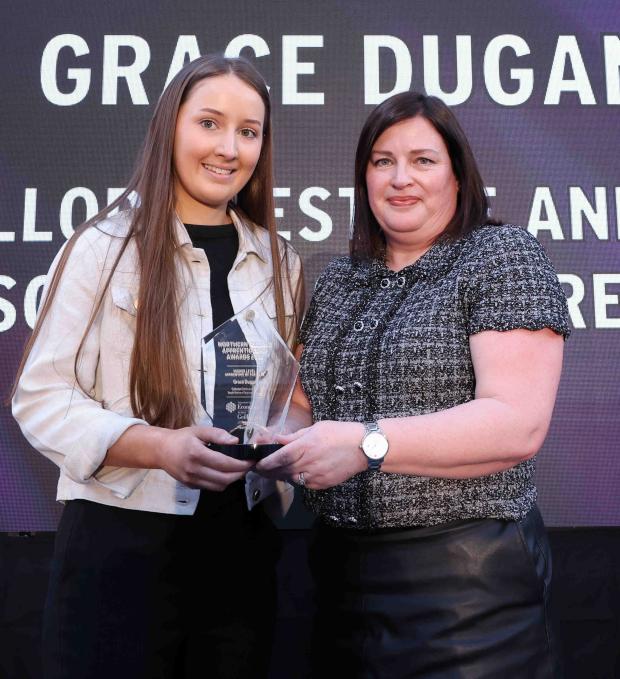
Grace’s response:
I chose a degree apprenticeship course over a traditional course because it enabled me to earn and learn at the same time, while building up several years of industry experience. I knew that the hands-on approach of an apprenticeship would be much more suited to me than an academic setting. It has also enabled me to climb the career ladder while gaining a valuable qualification.
Can you describe a typical day in your apprenticeship?
Grace’s response:
My days in work vary widely depending on the different functions and events that are taking place in the hotel. However, a typical day would look something like this:
Morning – Check daily schedule, preparing scones and afternoon tea patisserie
Afternoon – Afternoon tea service, preparing desserts for the other areas of the hotel, food ordering for the following day
Evening – Finishing desserts for restaurant dinner service, completing closing checks, write up next day duties for myself and chef de partie.
What kind of tasks or responsibilities do you handle as part of your role?
Grace’s response:
My role is Head Pastry Chef for the Culloden Estate and Spa, which means I am responsible for the entire pastry department at the hotel.
This includes:
- Research and menu creation and recipe development
- Food costing within set budgets and ordering
- Stock rotation management
- Ongoing training of junior staff members
- Maintaining high standards of kitchen hygiene
- Production of all desserts and afternoon teas for the hotel.
- Adapting menus for specific dietary requirements
- Liaise with front of house team
How does on-the-job learning compare to classroom-based learning?
Grace’s response:
I much prefer on-the-job learning as I have a very practical mindset and have always found that I learn the most by doing. It also makes the theory element of classroom learning more relatable.
However, the classroom parts of my Culinary Arts HLA were also extremely useful as it gave me an insight into kitchen management and the process of setting up a food business, both of which will be beneficial to my future career.
To date, what has been the most rewarding and most challenging part of your apprenticeship?
Grace's response:
Undoubtedly, the most rewarding part of my apprenticeship was winning the Higher Level Apprentice of the Year Award at the Northern Ireland Apprenticeship Awards 2026. It felt great to get this recognition, not only for my own apprenticeship journey, but also for my lecturers in South Eastern Regional College and mentors in the Culloden Estate and Spa. Their support and guidance throughout the entire process has been invaluable.
The most challenging part of my apprenticeship was learning to manage people of different ages, gender and cultures at a young age. Part of my course covered people management; however, initially I found dealing with this in a work environment much more challenging. Now, I have developed different management strategies that are best suited for each staff member that I am responsible for training.
Biography
I grew up on a family farm, which raised lamb, beef and vegetables, so food was a focal point of my life from an early age. At 16, once I completed my GCSEs, I started working in the kitchen of a small restaurant. I loved the kitchen environment and made the decision not to return to school for A levels.
Instead, I went to college to complete a Level 2 NVQ in Professional Cookery. I then took on a new position as a pastry chef and completed a Level 3 NVQ in Patisserie and Confectionery.
My lecturers at SERC brought a new Higher Level Apprenticeship course in Culinary Arts to my attention. This course allowed me to further my skills and explore food business development and management. It also offered an opportunity to take part in competitions, one of which resulted in a job offer at the Culloden Estate and Spa, which I willingly accepted.
I started as a Chef de Partie and quickly progressed to Junior Sous Chef within a year. After one year at this position, I accepted my current job role of Head Pastry Chef. I hope to continue to progress within the Hastings Hotels Group and hopefully open my own business in the future.