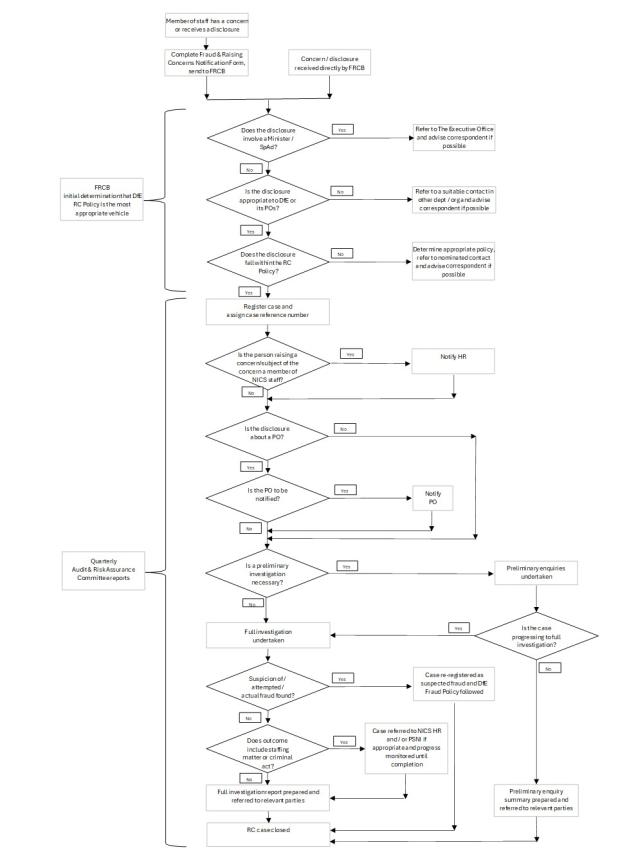
Department for the Economy Raising Concerns Response Plan
This is the latest version of the Department for the Economy Raising Concerns Response Plan (effective March 2026)
Introduction
The Department for the Economy (DfE) is keen to encourage anyone, staff or members of the public, who has a public interest concern, to have the confidence to raise it knowing that they will be listened to, taken seriously and supported.
In order to instil this culture, the Director of Corporate Governance has been appointed as the Department’s Speak-Up Champion, overseeing a dedicated Fraud & Raising Concerns Branch (FRCB).
This plan is based on the principle that the Department encourages staff and others to raise genuine concerns and will not tolerate harassment, victimisation or bullying under any circumstances as a result of a concern being raised.
This document details:
- the procedures to be followed by any member of DfE staff who receives an allegation or notification of a concern relating to suspected malpractice, risk, abuse or wrongdoing, either orally or in writing; and
- the procedures to be followed by managers who are responsible for ensuring compliance with the Public Interest Disclosure (NI) Order 1998 when concerns are raised by staff.
This response plan should be read in conjunction with the NICS Raising a Concern Policy Framework and the DfE Raising Concerns Policy.
It is important that these procedures are followed to ensure that:
- all concerns are referred to the appropriate person in the Department to be recorded and monitored centrally;
- the most appropriate action is taken, especially in cases that are complex and cover a range of fraud, governance, staffing or service-related issues;
- action is taken as swiftly as possible following receipt of a concern; and
- access to potentially sensitive information/issues is restricted, as far as possible, to preserve confidentiality and protect both the party raising the concern and any parties named in the concern.
The overarching theme of this plan, which applies to anyone at any juncture, is IF IN DOUBT, ASK FOR ADVICE.
Contact details for the DfE Speak-Up Champion and DfE FRCB:
- Address: Level 2, Adelaide House, 39-41 Adelaide Street, Belfast, BT2 8FD
- Confidential email:raising.concerns@economy-ni.gov.uk
- 24-hour phoneline with messaging facility: 028 9025 7422
- Direct Dial:57422
Receipt of Concerns
A concern may be raised by a member of DfE staff, a member of staff employed by the Department’s Partner Organisations (POs), an external stakeholder or a member of the public.
Concerns can be raised with the Department in relation to, for example, its own activities, one of its POs, a member of staff, a body receiving public funding or a contractor.
On receipt of a report of a concern, all Departmental staff have a duty to immediately report the matter to a line manager / Head of Branch. If there is concern that a manager may be involved, the matter can be reported to the next appropriate level. If a member of staff prefers, concerns may be reported directly to the Speak-Up Champion or FRCB using contact details provided.
If any member of staff/management is contacted by anyone, including a member of staff, who wishes to raise a concern, they must:
- listen to the concerns and treat every report received seriously and sensitively;
- make every effort to remember and record all relevant details, such as the date and time of, and what was said in, phone or other conversations;
- obtain as much information as possible, including any notes and evidence they have that may support their concerns;
- note the date of receipt of any documents and, where possible, the names of anyone involved;
- if a concern is brought by a member of staff, reassure them that they will be supported; and
- hold all evidence in a secure place until handed to FRCB.
Allegations may be made in a number of ways:
- telephone or face-to-face meeting – any written notes made during or after a conversation must be scanned and emailed to FRCB before the originals are handed to a member of the team or mailed to the address above;
- hard copy correspondence - other than recording the date received in the Department, DO NOT write on or otherwise mark any correspondence received. The correspondence must be scanned and emailed to FRCB before the originals are handed to a member of the team or mailed to the address above;
- email correspondence – must be forwarded to FRCB at raising.concerns@economy-ni.gov.uk as soon as possible. The subject line of the email must read ‘Official – Sensitive’.
- social media allegations - a screenshot / photo, capturing all relevant data, must be taken of the concern and must be forwarded to FRCB along with relevant links.
For any concern, your own or someone else’s, it will be necessary to hand over all letters, emails, notes and/or evidence obtained to the Speak-Up Champion and / or FRCB, so it is important to have as complete a record as possible.
Some allegations may be made anonymously. Investigating such allegations may be more difficult as FRCB will be unable to contact the person who raised the concern to obtain clarification or additional information. However, it is imperative that anonymous allegations are treated in the same manner as those where the person making the allegation has provided contact details.
In some cases, discussion of the context of an issue to a person contemplating making a public interest disclosure may be enough to alleviate their concerns. Minor issues might be able to be dealt with straight away by management.
Staff / managers MUST NOT do any of the following:
- contact anyone allegedly involved in the reported concern;
- discuss details of suspicions or allegations with anyone outside the Department;
- discuss the case with anyone in the Department other than the Speak-Up Champion or members of staff in FRCB;
- attempt to personally conduct investigations or question anyone as there is a risk that, in doing so, they could prejudice subsequent investigations or corrupt evidence;
- save any records. All material must be sent to FRCB who will retain in a secure container which cannot be accessed by anyone without a business need to do so.
On receipt of any concern, line management, normally the Head of Branch, must immediately complete a Fraud & Raising Concerns Notification Form with all relevant details and send this, together with all original supporting documentation, to FRCB at raising.concerns@economy-ni.gov.uk. It must not be copied to anyone else. FRCB will notify any parties who have a business need to know.
Concerns received by a Partner Organisation
A large part of the business of the Department is conducted through POs. A full list of our POs is available on our website here.
Directors with responsibility for POs will satisfy themselves that each has robust governance arrangements in place for dealing with public interest disclosures. It is the responsibility of each PO to:
- have up-to-date public interest disclosure guidance and procedures in place for staff and external stakeholders; and
- ensure that staff are aware of the procedures and know when and how to apply them.
If a member of staff in one of the Department’s POs has or receives a report of a concern, the Raising Concerns Policy of that organisation must be followed.
On receipt of a concern, a manager in the PO must immediately complete a Fraud & Raising Concerns Notification Form with all relevant details and send this, together with all original supporting documentation, to FRCB at raising.concerns@economy-ni.gov.uk, copied to their Partner Team. It must not be copied to anyone else. FRCB will notify any parties who have a business need to know.
Fraud & Raising Concerns Branch Handling of Concerns
After a concern has been raised or a notification received, FRCB will assess the detail of the concern to determine:
- that it is appropriate to the Department or one of its POs. If it is not, the concern will be forwarded to a suitable contact in another department or organisation and the person who made it advised accordingly;
- the nature of the allegation to ensure that the Raising Concerns Policy is the appropriate method of dealing with the matter raised. In completing this assessment, the issues in the following paragraphs must be considered.
Personal Complaints / Grievance: a Public Interest Disclosure must, by definition, affect others such as the general public. Personal grievances or dissatisfaction in respect of employment issues are not covered, unless an employee’s particular case is in the public interest. If the concern falls into this category, the member of staff will be advised of the correct avenue for advice and guidance.
Customer Complaints: if the matters raised are customer complaints, regarding a service provided by the Department, the complainant will be contacted and directed to the DfE Customer Complaints Procedure.
Section 75: if the matter raised is considered a Section 75 related issue, as outlined in the Department’s Equality Scheme, it will be referred to the Equality Unit and the person raising the concern will be advised.
Information Request: if correspondence is deemed to contain an information request under the Freedom of Information Act 2000, the Environmental Information Regulations 2004 or the Data Protection Act 2018, advice on the proper procedure will be requested from DfE’s Information Management Unit and action must be taken accordingly.
Suspected Fraud: if the concern is about attempted, suspected or actual fraud, the investigation will be conducted in line with the Department’s Fraud Policy and Fraud Response Plan.
If a concern has been raised by a member of staff and falls within the definition of a Protected Disclosure, the Public Interest Disclosure (Northern Ireland) Order 1998 will apply. FRCB will make the member of staff aware that they can contact Northern Ireland Civil Service Human Resources (NICS HR) to avail of advice and support.
If a concern relating to the activities or staff or the operations of a PO is sent directly to the Department, FRCB, with discussion as necessary with the Director of the Partner Team, Director of Corporate Governance Division (Speak-Up Champion) and the Head of Internal Audit (HIA) will consider:
- if it is appropriate that the PO is informed immediately;
- what action is required in order to deal with the matter raised;
- who will be responsible for any investigations. Where a disclosure relates to senior members of a PO’s staff or Board members, the Department will consider retaining ownership of the investigation. Consideration should be given to the role that the Board (and Audit and Risk Assurance Committee) of a PO might play in dealing with the case;
- depending on the nature and seriousness of the allegations, whether it is appropriate to draw the matter to the attention of the Grade 3, the Permanent Secretary, other internal or external stakeholders and/or the Special Adviser (SpAd) and Minister.
If confidentiality has been requested, the person raising the concern must be advised that the Department will comply with this, insofar as is possible. It is important that they are advised that, as the investigation progresses, there may circumstances where the Department is compelled to disclose information, for example, under court disclosure rules.
Minister and Special Adviser
If the concern relates to the Minister or SpAd then FRCB will refer the case to The Executive Office.
Decision Making for Investigations
If the assessment of a concern determines that it will be taken forward under the DfE Raising Concerns Policy, FRCB with input and advice as necessary from the Director of the relevant business area, the Director of Corporate Governance Division (Speak-Up Champion), the HIA or NICS HR (where allegations involve a member of departmental staff), will:
- decide if discreet preliminary enquiries are necessary. Where appropriate, discreet preliminary enquiries may be used to determine if there is a prima facie case to answer. If FRCB is satisfied from the initial allegation that this already exists, the case may immediately progress to full investigation;
- decide who is best placed to undertake enquiries. An investigation officer / team must be appropriately skilled, technically capable and impartial. Options may include the FRCB team, departmental staff, staff in a PO or an external specialist;
At this stage, the Director of the relevant business area, with advice as necessary from their Head(s) of Branch, may wish to consider if the circumstances of the concern pose any increased risk to their business. They must consider what action they deem necessary to minimise the risks, which may include, for example, moving a member of staff to other duties or restricting access to Departmental systems. In making decisions to mitigate risks through staff transfer or restriction of duties, the Head of Branch must consult with NICS HR. Advice may be taken from FRCB to ensure that any actions being considered do not have the potential to impede the investigation.
Investigations
It is essential that, in each case, the actions taken by the Department are proportionate, effective and timely, with the rationale for each course of action clearly documented. The investigation officer must keep a record of all enquiries, evidence gathered and conclusions reached.
If it is determined that discreet preliminary enquiries are appropriate, it is imperative that they do not prejudice subsequent investigations or corrupt evidence. Therefore, IF IN DOUBT, ASK FOR ADVICE.
If, after discreet initial enquiries are concluded, it is determined that there is no potential case to answer, no further action is necessary and the case will be closed. A short summary on the outcome of the preliminary enquiries must be completed.
If the preliminary enquiries have been undertaken by anyone other than a member of the FRCB team, the investigation officer must complete a Fraud & Raising Concerns Case Closure Summary and send to FRCB, accompanied by a copy of the summary of enquiries (redacted, if necessary). FRCB will, as required, notify the Director of the relevant business area (for DfE cases) or Partner Team (for PO cases).
If, however, it is determined that there is a potential case to answer, a full investigation is necessary and should be undertaken as soon as possible.
If, at any time, the investigation officer suspects or uncovers fraud, enquiries will temporarily cease to allow consideration of subsequent actions, which may include the potential involvement of the Police Service of Northern Ireland (PSNI). At this stage, the DfE Fraud Policy must be invoked.
During the course of an investigation, all staff have a responsibility to co-operate with requests for assistance, information and documentation.
Terms of Reference
Where a full investigation is undertaken, a Terms of Reference (ToR) must be drawn up to ensure that the focus of the enquiries is gathering sufficient reliable evidence to prove or disprove the concerns.
The Terms of Reference will:
- outline the specific concern(s) to be investigated;
- identify who will undertake the investigation;
- define the scope and objectives of the investigation;
- stipulate that a report will be produced;
- specify recipients of the final report; and
- agree costs (if appropriate).
FRCB can provide a template for a ToR and advice and guidance as required.
The ToR must be agreed with the Head of FRCB and relevant Director (if necessary).
Actions on Conclusion of an Investigation
On conclusion of an investigation, the assigned investigator will prepare a written report to the person(s) specified in the ToR. Where appropriate, the report will include:
- an executive summary;
- a summary of the evidence obtained in respect of each objective;
- a clear conclusion on each objective;
- any financial implications;
- any control issues identified;
- whether the report is being referred to NICS HR / PSNI / other relevant organisation.
If the investigation has been undertaken by anyone other than a member of the FRCB team, the investigation officer must complete a Fraud & Raising Concerns Case Closure Summary and send to FRCB, accompanied by a copy of the final investigation report (redacted, if necessary). FRCB will, as required, notify the Director of the relevant business area (for DfE cases) or Partner Team (for PO cases).
The Director of the relevant business area will determine what, if any, actions need to be taken within their Division.
Where identified, control issues may be notified to the HIA and should be used by management to review and enhance controls and procedures.
Police Service of Northern Ireland
Where it is likely that a criminal act has taken place, the case will be referred to the PSNI. This can occur at any stage of an enquiry, from receipt of the initial allegation through to the final report.
When required, FRCB will be responsible for PSNI referrals.
Following referral, it may be necessary to provide the PSNI with a Statement of Complaint. This will be signed, on behalf of the Department, by the Head of FRCB or a representative of the relevant business area.
FRCB will monitor the progress of cases referred to the PSNI.
Communication with the Person who Raised a Concern
Where contact details have been provided, communication channels will be maintained with the person raising a concern.
Where a disclosure relates to a PO, and the organisation has been informed of the investigation, agreement should be reached between the Department and the PO on responsibility for maintaining contact.
Where possible, receipt of your concern will be acknowledged within 10 working days of the date of receipt. If you submit your concerns to the Department’s dedicated mailbox you will receive an immediate auto acknowledgement.
With the exception of cases undertaken by a PO, FRCB will remain the contact point for the person who raised the concern unless the contact details of an assigned investigator are passed to them.
Depending on the nature of the concern and, where deemed necessary, the person who made the allegation may be contacted:
- to offer a meeting with a representative of the Department;
- to request additional information or clarification; and / or
- to notify them if their concerns are being referred to any other authority or organisation.
When enquiries are concluded, the person who raised the concern will be notified. Insofar as the Department is able, feedback will be provided on the outcome of the matters raised but it must be recognised that this will not be possible where this would infringe a duty of confidence owed by the Department to someone else.
Disciplinary Procedures and the Recovery of Losses
Where potential misconduct by a member of staff has been identified as an outcome to the investigation, the matter will be referred to NICS HR for consideration.
If any financial loss to the Department / PO is identified and quantified, recovery must be sought in all cases and the relevant business area should liaise with Finance Branch.
Fraud & Raising Concerns Branch
In order to provide DfE senior management with a clear understanding of the level and impact of public interest disclosures made to the Department, FRCB records and monitors all disclosures, their details and the actions taken to address them and reports to the Departmental Audit & Risk Assurance Committee (ARAC).
The Branch may also provide advice & guidance and document templates.
The Director of Corporate Governance Division (Speak-Up Champion) oversees the work of the Branch.
Document Review
FRCB will conduct a review of this Response Plan every two years or more frequently if required to ensure that it reflects current best practice.
Flowchart of Key Actions