Domestic Energy Efficiency and Low-Carbon Heat Programme (DEEHP) for owner-occupiers Consultation on the programme design proposals
Domestic Energy Efficiency and Low-Carbon Heat Programme (DEEHP) for owner-occupiers Consultation on the programme design proposals
Ministerial Foreword
I am pleased to launch this consultation on a new Domestic Energy Efficiency and Low Carbon Heat Programme. The transition to a cleaner energy system presents an important opportunity to strengthen our economy. Investment in energy efficiency and low carbon heat can support good jobs, develop skills and local supply chains, increase productivity and ensure that the economic benefits of decarbonisation are shared across our region.
Living in a warm home is a basic human right and contributes positively to supporting our physical and mental well-being, however our heavy reliance on fossil fuels to heat our homes leaves us exposed to volatile energy costs resulting from global events. Supporting homeowners to use energy more efficiently and move towards low carbon heating will reduce that dependence, strengthen our energy security and help protect consumers from future price shocks.
This programme aims to deliver up to £150m in investment, supporting the Energy Strategy ambition to transition away from fossil fuels to energy that has a more sustainable cost, and is affordable, secure and clean, by helping homeowners participate in the transition in a fair and affordable way. It will be a key contributor to deliver against the Energy Strategy targets in the region by delivering growth in the low carbon and renewable energy economy, increased energy savings and increased utilisation of renewable electricity.
This consultation seeks views on the design, delivery and funding of the programme. I encourage you to have your say and help us shape an approach that supports consumers, strengthens our economy and delivers a more secure, affordable and clean energy future.
Dr Caoimhe Archibald MLA
Minister for the Economy
How to respond
Consultation period: 25 November 2026 to 22 January 2027
This consultation seeks views on the proposed design of the Domestic Energy Efficiency and Low Carbon Heat Programme (DEEHP). Your responses will help the Department for the Economy (the Department) refine policy, delivery arrangements and programme administration before final decisions are taken.
- Online: Domestic Energy Efficiency and Low Carbon Heat Programme (DEEHP) for owner occupiers - Consultation on the programme design proposals
- Email: DEEHPConsultation@economy-ni.gov.uk
- Post: Heat Policy Team, Department for the Economy, Adelaide House, 39-49 Adelaide Street, Belfast, BT2 8FD
- Alternative formats: If you require this document in an alternative format (for example large print), please contact DEEHPConsultation@economy-ni.gov.uk.
The Department welcomes responses from individuals, community and voluntary organisations, local government, finance providers and other stakeholders involved in the installation or manufacture of insulation or heating systems. Where possible, please provide evidence or practical experience to support your views, including any expected impacts on households, delivery partners or the supply chain.
How we will use your information
The Department may publish a summary of responses and may disclose information in accordance with applicable legislation, including the Freedom of Information Act 2000, the Environmental Information Regulations 2004 and the Data Protection Act 2018. Where you provide personal data, it will be handled in line with the Department published privacy information. If you wish any information to be treated as confidential, please clearly mark it and explain why; however, an expectation of confidentiality cannot be guaranteed.
About this consultation
The DEEHP is being developed to replace the Northern Ireland Sustainable Energy Programme (NISEP). It will support owner occupiers to improve energy efficiency and adopt low-carbon heating in their homes. Outcomes of DEEHP include the reduction in overall energy demand, driving downward pressure on energy bills, reducing carbon emissions and supporting growth in the green economy. This consultation focuses on design choices, including who and what DEEHP should support, how it should be funded, and how quality and public value will be safeguarded through managed delivery.
The proposals in this consultation are intended to aid policy development, facilitate engagement and generate feedback. Detailed operational requirements and contract documentation will be developed separately, informed by responses to this consultation and further programme development.
This consultation is being published alongside an accompanying Scheme Design Report which sets out the evidence base and high-level design rationale. Respondents may find it helpful to read both documents together.
Key terms:
Energy efficiency refers to how well a home can provide a comfortable indoor temperature while using as little energy as possible.
Retrofit: Work to improve an existing building’s energy efficiency or reduce emissions from its energy use, rather than incorporating these features when a building is first constructed.
Measures: Individual improvements to a home to reduce energy use or carbon emissions, such as loft insulation, wall insulation or a heat pump. Eligible measures are those that the programme would allow grant funding to support.
Domestic heating decarbonisation means moving away from fossil fuel boilers such as oil and natural gas towards low‑carbon alternatives such as heat pumps.
DEEHP is being developed to help support households to take these steps in a practical and affordable way, recognising that homes differ widely in age, construction type, location and current heating fuel.
Commissioning is the process of testing and setting up a system, e.g. a heat pump or heating controls, so it operates correctly and efficiently.
Handover is when the household is given the information they need such as operating instructions, maintenance requirements and any certificates, so they can run the system safely and get the expected benefits.
Warranties set out what support the household can expect if equipment fails or if workmanship problems arise within a defined period.
Managing Agent: An organisation contracted by the Department to run the programme day to day within agreed rules and budgets. Under the proposed approach, it would coordinate applications, home assessments, installers, payments and quality checks, with the Department retaining oversight.
Installer / approved contractor: A person or business that carries out home energy improvements, such as fitting insulation or a heat pump. An approved contractor would be accepted to work under the programme and required to meet its standards and terms and conditions.
Northern Ireland Sustainable Energy Programme (NISEP): An energy efficiency programme operating since 2010, providing funding for energy-saving measures in homes and businesses, with a particular focus on vulnerable and low-income households.
Warm Healthy Homes Fund (WHHF): A new Department for Communities energy efficiency scheme, due to begin in 2027, which will provide support to improve the energy efficiency of lower-income households in owner-occupied and privately rented homes and will replace the Affordable Warmth Scheme.
Warm Homes Loan Scheme: A UK Government scheme launched in October 2026, providing government-backed, no- or low-interest loans to help households meet the upfront costs of clean energy technologies, including solar panels, battery storage and heat pumps. The scheme is available across the UK, including Northern Ireland.
At a glance – programme overview:
- Who: Homeowners who will benefit from support to improve energy efficiency and adopt low-carbon heating, with eligibility and evidence requirements designed to be fair and proportionate.
- What: The focus is on cost-effective energy efficiency improvements and, where appropriate, support for low-carbon heating systems, with protections to ensure suitability for the property.
- How: A centrally managed customer journey supported by digital processes and assisted routes for those who need them, with strong quality assurance.
Section 1: Strategic context
Introduction
In December 2021, the Northern Ireland Executive published ‘The Path to Net Zero Energy’1, setting the vision of how energy will be secure, affordable and clean both for now and for future generations. This Energy Strategy sets out a pathway to 2030 that will mobilise the skills, technologies and behaviours needed to achieve net zero carbon and affordable energy by 2050. In June 2022, the Climate Change Act (Northern Ireland) 20222 was introduced setting a legislative target of an at least 100% reduction in net zero greenhouse gas (GHG) emissions by 2050 compared to a 1990 baseline, along with interim targets including an at least 48% reduction in net emissions by 2030.
Energy accounts for just over half of GHG emissions3 in Northern Ireland with emissions resulting from a reliance on fossil fuel combustion across power, heat and transport. Although around half of our electricity is generated from renewable sources and energy-related sectors are reducing emissions faster than other sectors, our continued reliance on imported fossil fuels leaves household energy bills exposed to volatility in global wholesale commodity markets.
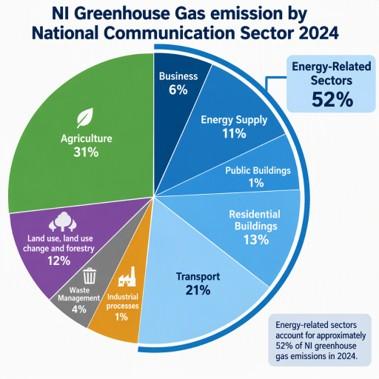
Note: Based on National Communication Sectors within the Northern Ireland Greenhouse Gas Inventory
Source: NI Greenhouse Gas Statistics 1990-2024
DEEHP is intended to be a key intervention for homeowners. It will replace the long-standing NISEP and provide grant support for households to take practical action to improve energy performance and transition to low-carbon heating, while helping grow the green economy.
NISEP has delivered a significant positive impact for consumers through its lifespan, however it was not designed to have the flexibility to scale or respond to changes in strategic direction now required to deliver the long-term transformation needed. A successor scheme builds on NISEP’s effective delivery model while providing a more coordinated and technology-aligned programme for improving building efficiency and supporting the transition to low-carbon heat.
In designing DEEHP, the Department must balance ambition with deliverability, and ensure public funds are used effectively, fairly and transparently. The programme’s objectives and design principles will shape decisions on eligibility, grant support, delivery arrangements and quality assurance.
It is important to recognise that whilst the Department for the Economy are taking forward this work to replace the Northern Ireland Sustainable Energy programme the Department for Communities are also working to bring forward a new fuel poverty focused intervention called the Warm Healthy Homes Fund. This fund will replace the Affordable Warmth Scheme in early 2027.
Supporting Evidence
To inform the development of the DEEHP the Department commissioned a programme of research to strengthen the evidence base for policy choices. In addition, significant learning and benchmarking from across the UK and Ireland has taken place alongside extensive stakeholder and industry engagement.
Overview of the Housing Stock
Our region’s housing stock includes a high proportion of older and rural properties which are reliant on fossil fuels for domestic heating, including significant use of oil, particularly in areas with no access to the gas network. These factors increase exposure to price volatility and present practical challenges for decarbonisation. A well-designed programme will support households to reduce their energy bills and improve overall thermal comfort. More broadly, the programme will support the energy transition by driving down energy demand and reducing carbon emissions.
We have a population of 1.93million with around 821,100 homes.4 The main house type in the region is detached (38%), followed by semi-detached and terraced (30% and 22% respectively). Households rely heavily on fossil fuels as the main source of heat via oil or gas central heating with 97% of homes are heated by these sources. In particular, the use of home heating oil is disproportionate when compared to GB and Ireland. This reliance on fossil fuels is a key driver for the DEEHP and provides opportunities to transform how we heat our homes.
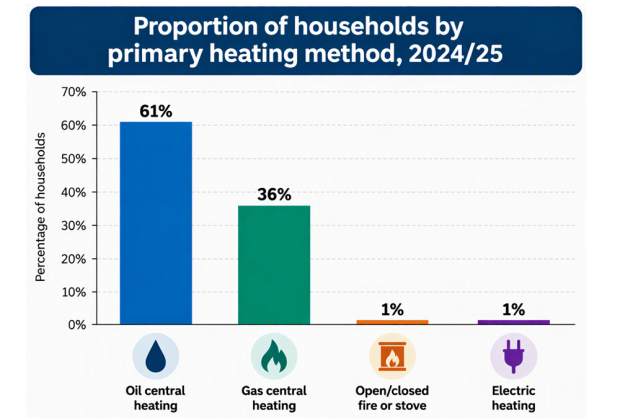
Notes:
- Electric Heating includes Electric Storage heaters (eg economy 7), Electric Fire/Heater and Dimplex Radiators
- Primary heating method respondent options included Other and None. The counts for these options were less than one percent or zero and have been excluded from the chart. Therefore, totals may not add to 100%
Source: Continuous Household Survey Heat and Insulation Results, 2024/25
Condition of the Housing Stock
Research into the different types of houses5 and on the future of energy efficiency policy6 indicates that the housing stock generally performs poorly in energy efficiency terms, with around half of homes requiring insulation improvements. Older properties, particularly those built before 1980, detached homes, rural dwellings and properties reliant on oil heating tend to be the least efficient. The research highlights the continued dominance of oil heating in many detached and semi-detached homes, while gas is more common in newer terraced properties and apartments. Key recommendations include expanding smart meter deployment to improve understanding of actual energy use and promoting greater uptake of renewable heating technologies such as heat pumps and solar panels.
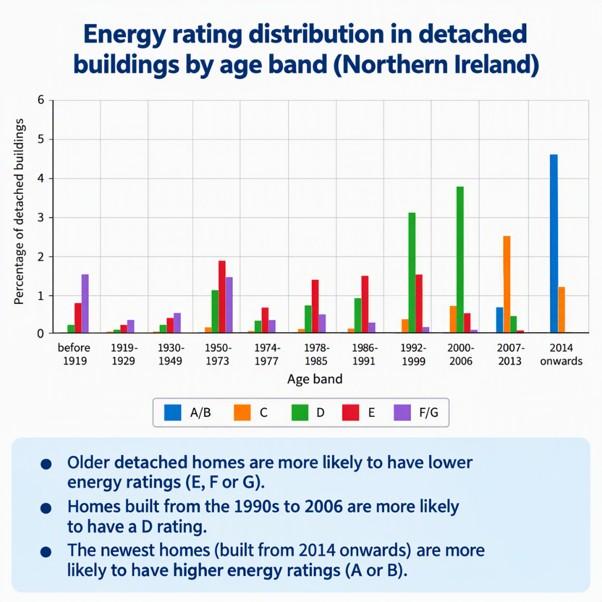
Notes:
- An Energy Performance Certificate (EPC) rates a property’s energy efficiency from A (most efficient) to G (least efficient), based on factors such as heating, insulation and energy use.
- Older detached homes are more likely to have lower energy performance ratings (E,F or G)
- Homes built from the 1990s to 2006 are more likely to have a D rating
- The newest homes (built from 2014 onwards) are more likely to have higher energy ratings (A or B)
Source: Development of Residential Energy Archetypes in Northern Ireland
Growing the Green Economy
Improving the energy efficiency of homes will require significant investment. Research suggests that this could bring significant benefits to the green economy and environment.7 Depending on the scale and type of investment, these improvements could add between £1.77 billion and £3.19 billion to the economy by 2050, support the equivalent of between 11,760 and 22,180 full-time jobs, and reduce greenhouse gas emissions by between 15.9 and 25.6 MtCO₂e. The research recommends starting with insulation and other improvements that can be delivered quickly, while installing more heat pumps, widening access to grants, exploring new ways to help households meet the costs and improving the data used to assess future options.
Workforce Assessment
A workforce assessment commissioned by the Department found that shortages of skilled workers and weaknesses in the supply chain could make it difficult to improve homes on a large scale.8 Delivering necessary number of heat pumps will require a significant full-time installers by 2032. However, uncertainty about future demand is making businesses less willing to invest in training and new skills. Shortages of skilled labour are most likely in heat pump installation, heat networks, insulation and the coordination of home improvements. The workforce is also ageing and there are not enough accredited installers. The report recommends providing greater certainty about long-term policy and funding, expanding training, building expertise, improving public awareness and addressing regional variations. Without early action, workforce shortages could limit the number of homes that can be improved.
DEEHP Design Plan
As part of the development of DEEHP the Department commissioned work to guide the scheme design, provide a gap analysis of current schemes and to benchmark against schemes currently operating across Britain and Ireland. The Scheme Design Report sets out proposals for a Domestic Energy Efficiency and Heat Programme (DEEHP), intended to accelerate residential decarbonisation by supporting owner-occupiers who are not covered by fuel poverty, social housing or other existing schemes. The proposed programme would commence as the NISEP scheme closes and use grants, primarily funding cost-effective insulation and the first-time adoption of low-carbon heating. A centrally appointed Managing Agent is identified as the preferred delivery model, providing an integrated customer journey while overseeing eligibility, installers, payments, quality assurance and regional delivery. Strong consumer protection is central to the design, including installer accreditation, technical assessments, risk-based independent inspections, warranties, complaints and redress arrangements. The programme is intended to be flexible, with grant levels, eligible measures and delivery arrangements adapting as evidence, market conditions and supply-chain capacity develop, and it would be introduced through a phased approach to allow capacity to build. Overall, the report presents DEEHP as a means of reducing household energy demand and carbon emissions, improving housing quality and comfort, lowering bills, stimulating retrofit activity and strengthening the low-carbon supply chain, while acknowledging that the emerging proposals require further consultation, market testing and refinement before implementation.
Implications drawn from the evidence
Taken together, this evidence supports a clear rationale for intervention. The case for action is reinforced by logic for reducing heat demand and supporting compatibility with lower-temperature heating solutions. Ensuring that retrofit programmes align with Just Transition principles to reduce inequality while supporting growth in the green economy are priorities for the Department.
Section 2: Programme overview
In summary, the following section outlines the main aspects of the programme as follows:
- Who: Eligible households who will benefit from support to improve energy efficiency and adopt low-carbon heating. Programme evidence requirements will be designed to be fair and proportionate.
- What: The focus is on cost-effective energy efficiency improvements and, where appropriate, support for low-carbon heating measures, with protections to ensure measures are suitable for the property.
- How: A centrally managed customer journey supported by digital processes and assisted routes for those who need them, with strong quality assurance.
Who is eligible?
Following clear feedback to the ‘Support for low carbon heat in the residential sector’ consultation it is intended that DEEHP will target owner occupiers, this represents the majority of homes in the region. Given the large number of households that could be eligible for the programme it will be necessary for the Department to prioritise support.
It is envisaged that, at launch, the Department for Communities (DfC) will already be providing grant support targeting fuel poverty. It is therefore proposed that DEEHP will dovetail with the DfC fuel poverty scheme, with eligibility for the scheme commencing above the Warm Healthy Homes Fund (WHHF) income thresholds and offer support for lower- and middle-income households who are not eligible for the WHHF. This funding would be offered on a first come, first served basis depending on overall budget availability.
Question 1 - Eligibility
The Department intend in providing a sliding scale of grant funding to households with a greater level of support provided to those with a lower income. This will be based on budget availability.
Do you agree with this approach?
- Select one: Yes/No
- Please provide reasons or evidence to support your answer.
What can grants be used for?
Homes differ in their age, design and location, so the improvements they need will also vary. For example, a rural home without mains gas may have different needs from a modern apartment in a town or city. DEEHP would therefore include an assessment of each home by a suitably qualified person to survey the current level of insulation and heating system. This will help identify the improvements that are most suitable for the property.
Question 2 - Suitable works
DEEHP will conduct home assessments, prior to work taking place, so that an objective decision can be made as to the suitable work for each home.
Do you agree with this approach?
- Select one: Yes/No
- Please provide reasons or evidence to support your answer.
Some of the most common feedback on existing support of this type is that they are highly complex and inaccessible to consumers. It is therefore intended that DEEHP simplifies the number of options available so that are easy to understand such as wall and loft insulation alongside replacement heating systems. This will not only simplify how DEEHP operates, it will enable swift conclusions to be drawn through home energy assessments and will also reduce the administrative burden on applicants. As DEEHP becomes more established the Department may wish to add further eligible options.
Question 3 - Energy improvements offered
The Department intends to include two core energy improvements in DEEHP. They are:
- Insulation – In a house, lofts and walls can be insulated to ensure that heat is retained within the house. Materials used for such insulation include expanded polystyrene, mineral wool, rigid foam boards, or natural fibres.
- Low Carbon Heat pumps – Are a highly efficient, electric heating system that transfers heat from the outside air, ground, or water into a building, rather than generating it directly.
Do you agree with the measures indicated?
- Select one: Yes/No
- Please provide reasons or evidence to support your answer.
Should insulation measures be prioritised?
Across Britain and Ireland there are a variety of approaches being taken to address whether insulation measures should be a pre-requisite to installing low carbon heating systems. This sequencing can help ensure that the final installation performs well, avoids unintended issues, and provides good value for money. This approach can also add upfront cost to any installation which can have long payback periods in terms of the overall savings gained. Given that households are facing historically high electricity prices it is intended that, at launch, DEEHP will require an adequate level of insulation to be installed before a property would be eligible for low carbon heating. This approach will be kept under review as technologies develop and smart meters begin to enable heat pump specific tariffs to create more favourable market conditions.
Question 4 - Targeting and sequencing
Following an initial home assessment and identification of appropriate measures a decision will need to be made about what measures will be adopted in each home.
Do you agree that a pre-requisite for insulation should be prioritised for a house, based on the findings of the home assessment for that property?
- Select one: Yes/No
- Please provide reasons or evidence to support your answer.
How will DEEHP be delivered?
‘Administration’ describes how a programme of this type is run in practice. It covers every stage for the householder, from their first enquiry and application to payment and aftercare. Programme management will affect how easy it is to use, how fairly and consistently decisions are made, and how problems such as poor-quality work are prevented and dealt with. Research with users and discussions with stakeholders have consistently shown that the process should be simple for householders.
Administration options
Delivering retrofit at scale requires a process that is easily understood, protects consumers, and provides consistent oversight of public funding. In other jurisdictions there are a range of delivery approaches, including:
- installer-led models;
- householder-led models; and
- centrally managed models.
In an installer-led approach (e.g. Boiler Upgrade Scheme in England and Wales) an installer may identify customers, recommend measures, submit applications and claim grant payments, with administrator mainly checking eligibility and evidence.
In a householder-led approach (e.g. Home Energy Scotland Grant and Loan) the household arranges quotes and contractors themselves and then submits evidence to claim grant support.
In a centrally managed approach (e.g. Warmer Homes Scotland) a single administrator coordinates the journey and acts as the main interface for households, often including home assessment coordination, installer assignment, installer approval and payment processing.
Each approach has advantages and disadvantages. These include how easy it is for households to use, how quickly work can be completed, whether the advice is independent, and how closely work is monitored.
A centrally managed or ‘Managing Agent’ approach
The Department proposes a centrally managed approach, delivered through a Managing Agent.
A Managing Agent is an organisation contracted to run a programme from day to day, following the Department’s rules and budget. Households would have one trusted service to guide them through the process. It would check whether they qualify, arrange or check home assessments, help them choose suitable improvements, organise the work, keep them updated and make sure the work is checked before payments are made.
This approach has proven an effective elsewhere, as it enables an end-to-end customer journey, separates delivery from assurance, enables proportionate risk-based inspections, and provides practical levers to support regional balance and market stewardship.
Question 5 - Management of services
The Department propose to use a Managing Agent to deliver the DEEHP.
Do you agree with this approach?
- Select one: Yes/No
- Please provide reasons or evidence to support your answer.
Managing approved contractors
It is proposed by the Department that the Managing Agent would go through a regular competitive process of inducting approved contractors into the programme to ensure both value for money and the cost of carrying out the work are considered. The department will set parameters within any contractual arrangements to ensure that those delivering the work remain responsible working safely and to required standards. It is also intended that installer terms and conditions will be published ahead of launch.
Question 6 - Managing Installers
The Department proposes that the Managing Agent would go through a regular process of inducting installers into the programme through a competitive process. Installers would be expected to operate within programme specific terms and conditions.
Do you agree with this approach?
- Select one: Yes/No
- Please provide reasons or evidence to support your answer.
Digital process
DEEHP will mainly use online services to make the process quicker, clearer and easier to manage. Households will be able to apply online, track their application, provide evidence, book a home assessment and, upload documents. People who cannot use online services will still be able to get help by telephone, through trusted community, voluntary and advice organisations or by using paper forms to ensure digitally excluded households are not disadvantaged.
The programme will need information about households and their homes to check who qualifies, recommend suitable improvements and confirm that the work has been completed. Some of this information may be personal or sensitive. It will therefore need to be stored securely, seen only by authorised people and kept only for as long as necessary. Households will also be told clearly how their information will be used.
Question 7 - Digital-first delivery
The Department proposes that DEEHP will adopt a digital first approach to delivery whilst ensuring that digitally excluded households are not disadvantaged.
Do you agree with this approach?
- Select one: Yes/No
- Please provide reasons or evidence to support your answer.
Section 3: Quality assurance
Customer support, protection and complaints handling
Clear and accessible customer support is important for any investment programme of this type. An approach for enquiries, applications and case updates, supported by digital channels and a telephone service can help ensure households receive consistent information, understand what evidence is required from them, and know what to expect at each stage.
Complaints will require to be handled in a way that provides a timely resolution and maintains public confidence. This will include:
- clear standards of service,
- an expectation that installers seek to resolve issues in the first instance, and
- defined escalation routes to the Managing Agent.
Why quality assurance matters
Quality checks are important to make sure that home improvements provide the expected benefits and are safe. Poor-quality work, different standards or inadequate checks can cause problems such as damp and mould, heating systems that do not work properly, and poor air quality inside the home. These problems could reduce public confidence in the programme and make it less effective.
While designing DEEHP, the Department identified a risk that government-funded programmes may use different quality checks and standards. As there is currently limited home improvement work and a relatively small installer sector in Northern Ireland, government departments and public bodies should work together to use similar requirements. This would help improve quality while training and support are put in place to protect both homeowners and workers.
Although government-funded programmes should use similar standards, DEEHP will have its own centrally managed quality checks. These will provide the same standard of service to every household, regardless of where they live or the type of improvement installed. There will be clear responsibility for quality, and the checks will be improved as the programme grows. Work will need to be designed, installed, inspected and tested to agreed standards. Installers will need the right skills, completed work will be checked, complaints will be dealt with properly, and households will receive clear information about using technologies. These checks will protect quality while allowing the programme to run efficiently and provide value for money. The Department will maintain oversight of programme delivery through its contract management arrangements with the Managing Agent, including monitoring performance and compliance with agreed programme requirements
Question 8 - Quality assurance
Whilst DEEHP will have standalone quality assurance processes, the intention is to align installer standards, minimum training requirements and certifications across all government funded home energy work.
Do you agree with this approach?
- Select one: Yes/No
- Please provide reasons or evidence to support your answer.
Handover documentation, warranties, and customer support
When installing heating systems in particular, clear commissioning and handover processes can be important to ensure systems operate as intended and that households understand how to use them efficiently. For insulation there is a much lower likelihood of follow up attendance from installers being required.
To protect consumers and support long-term performance, the Department will ensure requirements for clear documentation and customer support. This will include handover information such as user guides and operating instructions, evidence of commissioning and completion, follow up attendance from installers and appropriate warranties.
Question 9 - Aftercare
The Department proposes to place minimum requirements on installers, particularly when new heating systems are installed, to ensure appropriate levels of aftercare is available.
Do you agree with this approach?
- Select one: Yes/No
- Please provide reasons or evidence to support your answer.
Section 4: Finance
DEEHP will provide financial support to reduce the upfront cost of home energy improvements such as insulation and heat pumps. This support will come in the form of a grant which can be used to fully or part fund measures installed.
- A grant is money from the government to help pay for approved work. It does not need to be paid back if the programme rules are followed.
- Some programmes pay only part of the cost. The household must pay the rest.
- A cap is the most the programme will pay towards one improvement, such as insulation, or a package of improvements.
The UK Government has recently launched the Warm Homes Loan Scheme9 which offers low-interest loans for some of the same technologies supported by DEEHP. Several of the loan products offered by lenders and partnering installers are available in Northern Ireland. It is therefore important that consideration is given to enabling households to use a mix of grants and loans to pay for home energy improvements and the Department will take this into account when finalising the programme.
The Department is seeking views on how to provide financial support fairly, at a suitable level and within the current constrained financial climate.
Funding sources
DEEHP will need a significant, multi-year funding commitment. The Department proposes to continue using NISEP’s current source of funding. This continuation of current funding will provide stability in the early years of programme which would then be complemented by additional government funding.
Public Service Obligation
NISEP is currently funded through the Public Service Obligation (PSO) which is a mechanism used to balance certain costs that are separate from the normal operation of the electricity networks and wholesale market such as government policy.
Currently, the PSO provides funding for NISEP. Some changes to the Northern Ireland Electricity distribution licence will need to be made to ensure funding can be used for DEEHP. The Department proposes to work with the Utility Regulator and Northern Ireland Electricity on the new arrangements to enable the launch of DEEHP. In tandem, the Department will assess the need for legislative change to allow any future changes to the funding mechanism through an appropriate process.
The PSO currently raises around £8m per year from electricity bills. The Department proposes to ringfence this element of funding within DEEHP for lower-income households in a similar way to NISEP currently.
Question 10 - Public Service Obligation
The Department proposes that funding gathered through the Public Service Obligation (PSO) will be utilised within DEEHP for low-income households.
Do you agree with this approach?
- Select one: Yes/No
- Please provide reasons or evidence to support your answer.
Additional funding
One reason for replacing NISEP is to create a programme that can expand when more funding becomes available. DEEHP aims to deliver three times as many home energy improvements as NISEP annually, so it will need additional funding. Several policy documents support improving homes to reduce energy use and carbon emissions. The Programme for Government 2024–202710, the Northern Ireland Energy Strategy11 and the draft Northern Ireland Climate Action Plan 2023–202712 all commit to improving the energy efficiency of homes and reducing their carbon emissions. The Programme for Government supports long-term funding and partnership approaches to help tackle fuel poverty, reduce emissions from homes, support green jobs and grow the economy. The Energy Strategy sets out the longer-term plan for making buildings more energy efficient in the transition towards delivering net zero and affordable energy. It recognises that improving homes can reduce carbon emissions and support economic growth. The draft Climate Action Plan also explains how improving the energy efficiency of buildings will help meet legally binding carbon budgets. Together, these policies provide a strong basis for supporting home energy improvements and the move to low-carbon heating.
Question 11 - Additional funding
The Department proposes that any additional funding provided by the NI Executive will be utilised within a tiered grant structure depending on household income with the aim of being open to all households.
Do you agree with this approach?
- Select one: Yes/No
- Please provide reasons or evidence to support your answer.
Section 5: Conclusions and next steps
DEEHP represents a significant opportunity to reduce bills, support decarbonisation and grow the supply chain. The Department will consider all consultation responses alongside the evidence set out in the associated research, scheme design report, further programme development and statutory assessments.
After the consultation closes, the Department will analyse the responses and prepare a departmental response document for consideration by the Economy Minister. The Department will then progress detailed terms and conditions and operational design before any final decisions on launch arrangements are taken.
Final comments
If you wish to provide any additional views that are not covered by the questions above, please include them in your response. Where possible, please explain the evidence or experience that underpins your views and any impacts that you consider relevant.
Question 12 - Overall direction
Having considered the design options outlined within the consultation, do you agree with the emerging design direction for DEEHP?
- Select one: Strongly agree / Agree / Neither / Disagree / Strongly disagree / Not sure
- Please provide reasons or evidence to support your answer.
References
- ^The Path to Net Zero Energy. Safe. Affordable. Clean.
- Climate Change Act (Northern Ireland) 2022
- Northern Ireland greenhouse gas inventory 1990 – 2024 statistical bulletin | Department of Agriculture, Environment and Rural Affairs
- Census 2021 results | Northern Ireland Statistics and Research Agency
- Development of Residential Energy Archetypes in Northern Ireland
- Research into the future of energy efficiency policy in Northern Ireland
- Investigating the potential for economy wide impacts of energy efficiency improvements in NI
- Low carbon heat & energy efficiency workforce assessment
- Warm Homes Loan Scheme: Overview - GOV.UK
- Programme for Government 2024-2027 ‘Our Plan: Doing What Matters Most’ | The Northern Ireland Executive
- Energy Strategy - Path to Net Zero Energy - 2024 Action Plan Report
- Northern Ireland’s draft Climate Action Plan 2023-2027 | Department of Agriculture, Environment and Rural Affairs
Printing this content